
Summary Points
- Addiction in athletes is often rooted in trauma and nervous system dysregulation, not lack of discipline.
- Eye Movement Desentization and Reprocessing (EMDR therapy) helps reprocess traumatic memory networks that drive cravings and emotional reactivity.
- Internal Family Systems (IFS) helps athletes understand protective parts like the inner critic or overtrainer.
- Integrating EMDR and IFS reduces shame, supports relapse prevention, and improves performance regulation.
- Sustainable performance requires nervous system regulation, not just mindset shifts.
A Nervous System Behind Every Performance
Last week, I spoke on a panel at a conference for athlete mental health about how EMDR and IFS support addiction recovery, athletic performance and care for the Human first before the performer/player.
One central message shaped the conversation:
ATHLETES are told to move on forget, think like a goldfish, but the HUMAN nervous system remembers looking for patterns, prediction to help with survival.
When that nervous system has been shaped by injury, shame, pressure, or trauma, coping strategies such as substance use often make sense from a survival perspective.
Athletes are frequently told to:
- “Move on.”
- “Forget the mistake.”
- “Think like a goldfish.”
While cognitive strategies can interrupt rumination, they do not resolve trauma stored in the nervous system. The body remembers for survival. When trauma remains unprocessed, the system stays in protection mode.
And protection mode drives behavior.
The Hidden Layer: Trauma in and Outside of Sport
Addiction in athletes is often framed as a behavioral issue:
- Substance misuse
- Pain medication dependence
- Performance-enhancing substances
- Compulsive overtraining
But OFTEN underneath these behaviors are trauma-linked memory networks, including:
- Injury and loss of identity
- Performance trauma
- Public mistakes, social media threats/comments
- Coaching dynamics
- Early life adversity
- Shame experiences
When these experiences remain unprocessed, the nervous system continues reacting as if the threat is present.
Protection mode can look like:
- Emotional shutdown
- Risk-taking
- Avoidance
- Overtraining
- Substance use to regulate activation
Athletes cannot think their way out of a trauma response. Body- and brain-based approaches like EMDR therapy and IFS are powerful for nervous system healing.
What Is EMDR — and Why It Matters for Athletes
EMDR (Eye Movement Desensitization and Reprocessing) is an evidence-based trauma therapy that helps the brain reprocess distressing memories.
Rather than erasing memory, EMDR helps the nervous system integrate experiences that are still firing as if they are happening now.
For athletes, EMDR can:
- Reduce emotional reactivity tied to injury or mistakes
- Decrease shame linked to performance events
- Lower trauma-driven cravings
- Support relapse prevention
- Improve nervous system regulation
EMDR therapy addresses the root — not just the symptoms.
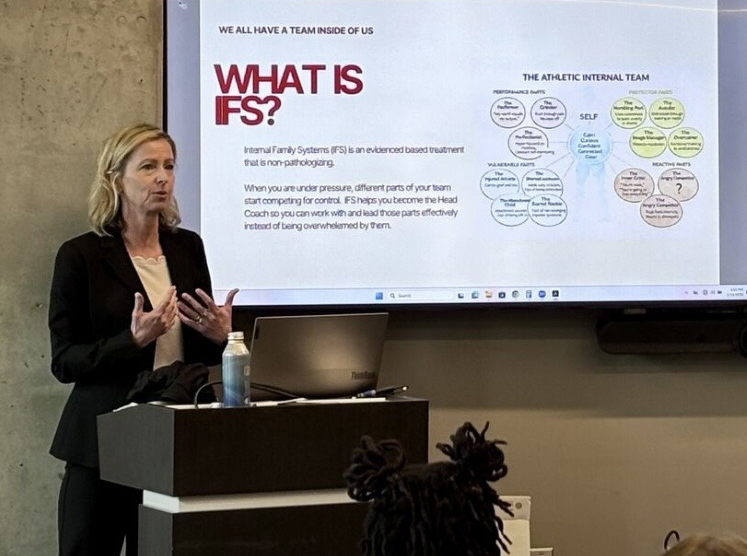
What Is IFS? We All Have a Team Inside
Internal Family Systems (IFS) offers a non-pathologizing, strength-based model for understanding internal dynamics.
IFS recognizes that we all have protective “parts.” Under pressure, athletes may experience:
- The Perfectionist
- The Inner Critic
- The Overtrainer
- The Numb One
- The Angry Defender
- The Ashamed Part
- The Driven Captain
These parts are not flaws. They developed to protect the system.
IFS helps athletes:
- Identify protective parts
- Understand what those parts fear
- Reduce internal shame
- Lead from a grounded “Self” of “Coach” rather than reactive survival strategies
Instead of fighting internal experiences, we build relationships with them.
Why Integration Matters: EMDR + IFS
When EMDR and IFS are integrated, powerful shifts occur:
- IFS identifies protective parts driving behaviors like substance use.
- EMDR reprocesses the traumatic memory networks that those parts are guarding.
- Nervous system regulation improves.
- Shame decreases.
- Agency increases.
This is where recovery and performance intersect and humans thrive.
Because regulation is performance.
The Nervous System and Addiction in Sport
Addiction is not simply a failure of willpower. Often, it reflects a nervous system attempting to regulate:
- Hyperactivation (fight/flight)
- Collapse (freeze/shutdown)
- Emotional overwhelm
- Identity disruption after injury or transition
Substances and behaviors may temporarily provide:
- Soothing racing thoughts and anxiety
- Numbing overwhelm
- Energy, control or relief
- Escape
But long-term recovery requires trauma integration, not suppression. Substances and behaviors can work in the short term by shifting the nervous system state, but they don’t help reset it to work as it should, they override it.
Healing the nervous system reduces relapse risk and enhances sustainable performance.
Using Athlete-Informed Language
Language shapes recovery.
Instead of asking:
- “What’s wrong with you?”
We ask:
- “What happened?”
- “What part of you is trying to protect you?”
- “When did this response first show up?”
Or we might offer: “Your nervous system learned to rely on this” or the idea of “returning to an old play under stress”
Reducing shame increases engagement.
Engagement supports nervous system safety.
Safety supports recovery.
What This Means for Coaches, Clinicians, and Organizations
If we want sustainable performance and long-term well-being:
- Address trauma, not just behavior.
- Regulate nervous systems, not just correct habits.
- Understand protective strategies instead of punishing them.
Athletes are not broken.
Their nervous systems are adaptive as are all human nervous systems.
When we work with the system — not against it — transformation becomes possible.
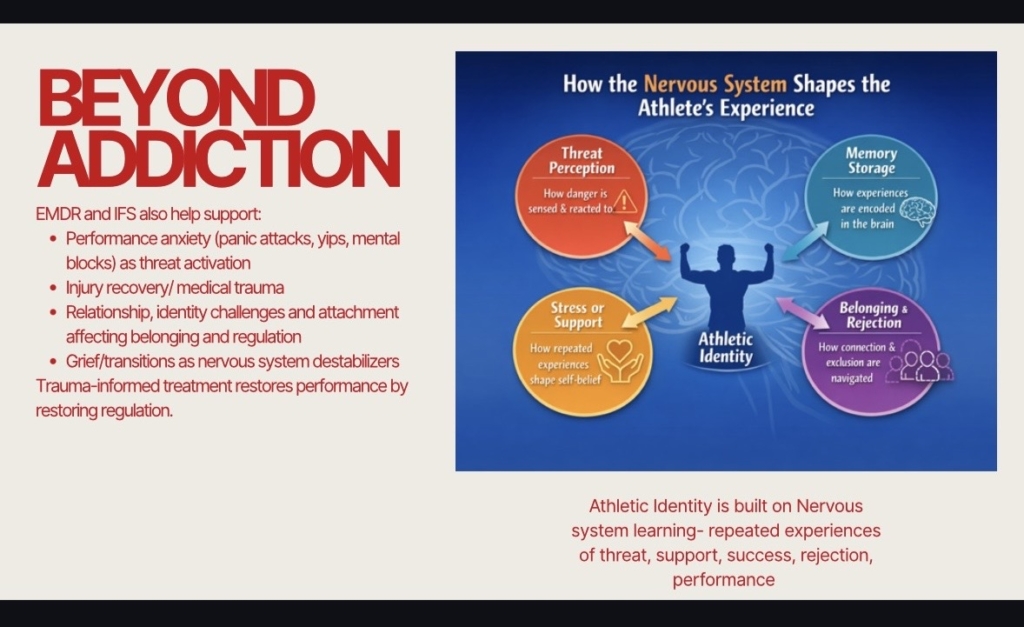
Beyond Addiction: Additional Applications of EMDR and IFS in Sport
EMDR and IFS also support:
- Performance anxiety
- Panic attacks
- The yips
- Mental blocks
- Injury recovery and medical trauma
- Relationship stress
- Identity transitions
- Attachment wounds
- Grief
Trauma-informed care enhances both mental health and athletic longevity.
Final Reflection
Athletes are often given more external advice, more strategies and more techniques. But regulation is not a cognitive skill- it’s a physiological one. The key to resetting the nervous system isn’t forcing different thoughts. It’s engaging the body, increasing coherence, and helping the system update its patterns and predictions. When we work with the body’s responses, we don’t just improve performance- we restore safety. The nervous system is always scanning for safety and connection.
EMDR therapy and Internal Family Systems offer structured, evidence-based pathways to help athletes:
- Heal trauma
- Reduce shame
- Regulate their nervous systems
- Decrease relapse risk
- Perform from integration rather than survival
This is not just about addiction recovery.
It is about humanizing health and mental health in the sports world.
And that work is worth doing.