

Key Takeaways
- Brain integration for athletes is about helping the entire nervous system work together more efficiently.
- Peak performance depends on communication between brain regions—not simply positive thinking or mental toughness.
- Stress, trauma, and overwhelming experiences can interrupt this communication and create performance blocks.
- Integration doesn’t erase difficult memories; it changes how the brain stores and responds to them.
- EMDR therapy may help athletes integrate unresolved experiences and regain access to their natural abilities.
- Elite performance often emerges as a byproduct of a well-integrated nervous system rather than relentless mental effort.
For decades, we have trained athletes and high performers to become mentally tougher. Modern neuroscience is offering us a different goal: brain integration for athletes.
I often share with athletes that their performance improves when their brains become more integrated.
Not simply calmer.
Not simply more confident.
Not simply more motivated.
More integrated.
Performance isn’t controlled by one part of the brain.
It emerges from communication across the entire nervous system. High performance isn’t about forcing a dysregulated system to perform. It comes from helping the system work together more efficiently.
Imagine a goalkeeper in the World Cup moments before defending a free kick. Within seconds, the brain must evaluate threat, regulate emotion, focus attention, and prepare the body for explosive movement. Heart rate rises. Adrenaline surges.
The old advice might have been to ignore those sensations.
Modern neuroscience suggests something different.
The brain doesn’t perform best when it suppresses arousal. It performs best when regulated, allowing the nervous system to use that energy rather than becoming overwhelmed.
Brain Integration for Athletes Begins with Teamwork Inside the Brain
As athletes, we often imagine the brain as a star player.
In reality, it functions more like a championship team.
High performance depends on both horizontal integration (communication between the right and left hemispheres) and vertical integration (communication between the brainstem, limbic system, and cortex). Neuroscience refers to this as neural coherence—the degree to which different brain regions communicate effectively.
Each region specializes in different functions while constantly working together.
When communication breaks down because of chronic stress, overwhelming experiences, or unresolved trauma, execution suffers—even when physical talent and determination remain intact.
This is why athletes who are overthinking, anxious, or emotionally overwhelmed often experience performance blocks.
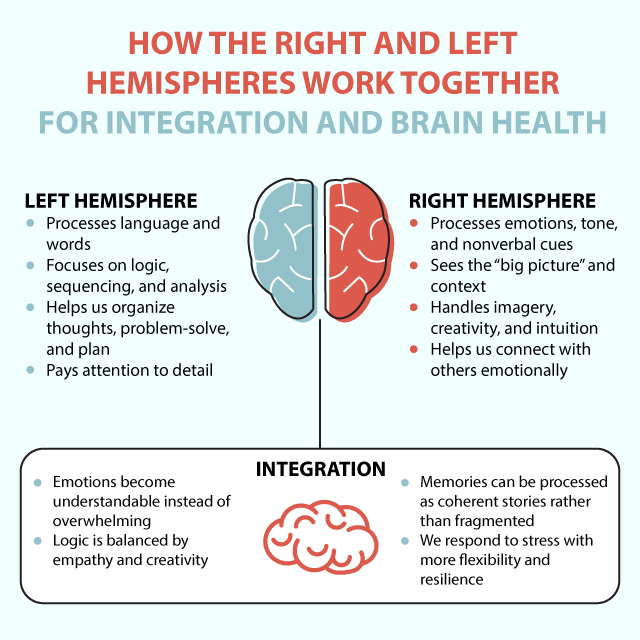
One helpful way to understand this is through the brain’s two hemispheres.
Generally speaking:
- The left hemisphere supports language, sequencing, analysis, planning, and logical problem-solving.
- The right hemisphere contributes to emotional experience, body awareness, intuition, creativity, implicit memory, facial recognition, and present-moment awareness.
Great performance requires both.
The athlete who trusts instinct while executing a carefully practiced game plan.
The quarterback who rapidly reads a defense while staying connected to rhythm and feel.
The gymnast who analyzes technique during practice but competes almost automatically.
When the brain is integrated, these systems collaborate rather than compete.
In highly integrated states, the brain demonstrates greater neural coherence. Athletes aren’t consciously thinking about every movement because efficient neural pathways allow automatic performance to emerge.
How Stress Disrupts Brain Integration for Athletes
Stress changes the conversation inside the brain.
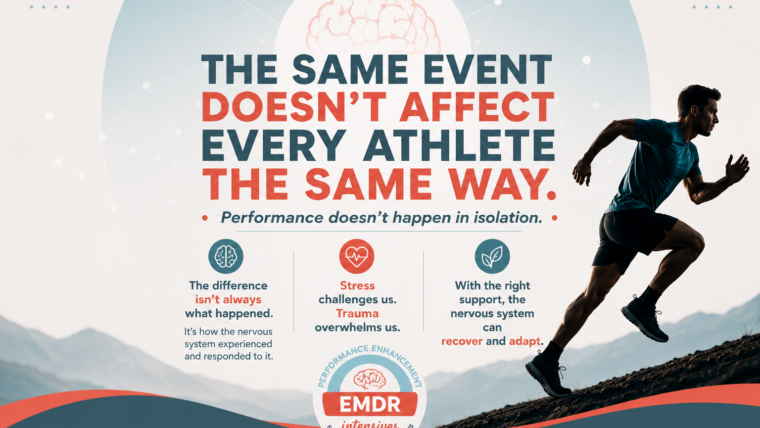
When an experience becomes overwhelming—whether it’s a traumatic injury, repeated failure, public criticism, or a single devastating mistake—the brain may store it in a fragmented way.
Instead of becoming part of a coherent life story, the memory can become isolated within neural networks below conscious awareness.
Thoughts.
Emotions.
Physical sensations.
Images.
Performance memories.
Later, situations that resemble the original experience may reactivate those same networks.
The athlete logically knows they’re safe.
But the nervous system responds as though the original threat is happening again.
This helps explain why athletes often say:
“I know what to do… I just can’t do it.”
The problem usually isn’t a lack of knowledge or skill.
It’s a temporary loss of access to existing abilities because the nervous system has been pulled into an older, unintegrated response.
Brain Integration Doesn’t Mean Erasing the Past
One of the biggest misconceptions about trauma treatment—or mental performance—is that the goal is to erase difficult memories.
It isn’t.
The goal is integration.
The memory remains.
But it no longer dominates the present.
The emotional charge shifts.
Instead of reacting automatically, the brain becomes flexible again.
Athletes regain access to the full range of their skills, decision-making, emotions, and movement patterns that were always available beneath the surface.
How EMDR Supports Brain Integration for Athletes
This is one reason I value Eye Movement Desensitization and Reprocessing (EMDR) therapy when working with athletes and performers.
EMDR isn’t simply about talking through difficult experiences.
It helps the brain reconnect information that became separated when the nervous system was overwhelmed.
Research suggests that bilateral stimulation—the alternating left-right stimulation used during EMDR—may facilitate communication across brain networks while reducing the emotional intensity associated with distressing memories.
Rather than forcing change through willpower alone, the brain is given an opportunity to process experiences in a more adaptive and integrated way.
Although the precise mechanisms remain under study, growing evidence supports EMDR’s ability to help previously “stuck” memories integrate into broader memory networks.
As this happens:
- Thoughts align with emotions.
- Emotions align with the body.
- The body aligns with performance.
EMDR supports integration that may not have occurred naturally after overwhelming experiences, while Performance EMDR builds on that foundation with a strengths-based approach.
Athletes often describe the result in remarkably similar ways.
They simply feel like themselves again.
Not because someone taught them a better motivational phrase.
Because their nervous system regained flexibility.
The Human Being Comes Before the Athlete
One of the themes I continually return to is that elite performance starts with the human being—not simply the athlete.
When the brain becomes integrated:
- Confidence becomes more stable.
- Decision-making becomes clearer.
- Relationships improve.
- Recovery improves.
- Performance often follows.
Not because we’re chasing performance.
But because we’re supporting the whole person behind it.
Perhaps that’s the paradox.
The more integrated the person becomes, the more freely performance can emerge.
High performance is often the outward expression of an integrated nervous system.
The goal isn’t simply resilience.
It’s brain integration for athletes.
Because integrated brains perform differently.
Want to better understand how the brain’s two hemispheres work together to support performance and resilience? Read Human First: How the Right and Left Hemispheres of the Brain Work for Integration and Brain Health to explore the neuroscience behind integration in greater depth.