

Key Takeaways
- Understanding athlete nervous system recovery helps coaches, parents, clinicians, and athletes provide the right kind of support.
- Stress is a normal and necessary part of athletic development.
- Trauma occurs when an experience overwhelms the nervous system’s ability to process and integrate what happened.
- Two athletes can experience the exact same event yet have very different nervous system responses.
- Recovery is determined not only by what happened, but by how the nervous system stores and processes the experience.
- Healing is not about becoming mentally tougher—it is about restoring the nervous system’s ability to adapt.
Performance doesn’t happen in isolation. It emerges from the interaction of the nervous system, identity, relationships, and lived experience.
“No pain, no gain.”
“What doesn’t kill you makes you stronger.”
“Athletes get injured.”
“Athletes get benched.”
“Athletes experience failure.”
Sport has long celebrated the idea that adversity builds character. And often, it does.
Stress is a normal—and necessary—part of athletic development. Training challenges the body. Competition stretches our limits. Learning from mistakes helps us grow.
But what happens when an experience doesn’t simply challenge us? What happens when the nervous system continues to carry it long after the event is over in a live-replay form?
That’s where understanding the difference between stress and trauma becomes important.
Stress Helps Us Grow
Stress is an ally, not an enemy.
In the right amount, and with adequate recovery, stress helps athletes adapt, learn, and become more resilient. Every practice, competition, injury rehabilitation, difficult conversation, and pressure-filled moment asks something of the nervous system.
When challenge is followed by recovery, growth occurs.
Resilience isn’t built by avoiding stress. It develops by experiencing manageable stress, having opportunities to recover, and maintaining enough safe connection to process life’s experiences.
This is one of the foundations of athlete nervous system recovery. The nervous system is designed to adapt when challenge and recovery remain in balance.
When Does Stress Become Trauma?
Researchers increasingly describe stress and trauma as existing on a continuum rather than as completely separate categories.
Stress becomes problematic when the demands placed on the nervous system consistently exceed our capacity to recover.
Think of an athlete who is sleep-deprived, traveling across time zones, competing without adequate recovery, and spending extended periods away from supportive relationships and identity outside of sport.
Trauma occurs when an experience overwhelms the nervous system’s ability to process and integrate what happened.
In simple terms:
- Stress challenges us.
- Trauma overwhelms us.
The distinction isn’t simply about the event itself. It’s also about how the nervous system experiences, stores, and adapts to that event.
Athlete Nervous System Recovery: Why Do Some Athletes Bounce Back While Others Don’t?
This may be one of the most important questions in sports psychology.
Why do two athletes experience the same injury, the same coaching style, or the same heartbreaking loss, yet one moves forward while the other feels stuck for months—or even years?
The military has long recognized an important principle:
Exposure does not automatically equal trauma.
Two service members can experience the same event. One develops lasting symptoms, while the other integrates the experience and recovers.
The same principle applies to athletes.
This understanding is foundational to trauma-informed care, yet it is still often misunderstood in sport.
Too often we hear:
- “Athletes will face tough coaching at some point”
- “This is part of the game you signed up to play”
- “You are getting paid (this is your job) so deal with it”
- “Athletes gets injured.”
- “Athletes gets criticized.”
- “Athletes experiences failure.”
Those statements can be partial true;
But they don’t explain why the impact differs from athlete to athlete.
Instead of asking,
“Was the event stressful?”
or expecting the athlete to fully explain their experience, perhaps we should become curious about a different question:
“How did this athlete’s nervous system experience and store that event?”
Believe me, this isn’t necessarily the question you ask the athlete directly. Rather, it provides a framework for understanding what you’re observing and for helping athletes recognize that their body’s responses are communicating something important.
That shift moves us away from assumptions about mental toughness and toward genuine understanding.
Trauma Doesn’t Always Look Dramatic
Often when people hear the word trauma, they often think of catastrophic events.
Yet many experiences in sport can overwhelm the nervous system and activate a threat response below conscious awareness without ever making headlines.
Examples include:
- a season-ending or career-ending injury
- repeated public humiliation
- emotional abuse from a coach
- witnessing a medical emergency on the field
- chronic criticism that becomes tied to identity
- unexpectedly losing a roster spot or scholarship
The event alone doesn’t determine whether it becomes traumatic.
Previous life experiences, attachment history, available support, genetics, timing, and personal meaning all influence how the nervous system responds.
Athlete Nervous System Recovery Isn’t About Being Mentally Tough
One misconception I’d love to see our sports culture move beyond is the idea that recovery is simply a measure of willpower.
From the perspective of Eye Movement Desensitization and Reprocessing (EMDR)’s Adaptive Information Processing (AIP) model, the brain is naturally designed to process and integrate life’s experiences.
Most of the time, it does this remarkably well.
But when an experience overwhelms the nervous system, that adaptive processing can become disrupted.
Instead of becoming part of the past, aspects of the experience remain “stuck,” continuing to influence thoughts, emotions, physical sensations, and performance in the present.
Remember how I often describe it as game film stuck on repeat. Instead of reviewing the film, learning from it, and filing it away, the replay keeps looping.
This doesn’t mean an athlete is weak.
It means the nervous system hasn’t fully recovered.
How Do You Know Whether You’re Experiencing Stress, Trauma, or Both?
The answer isn’t always straightforward.
Many athletes experience both chronic stress and unresolved traumatic experiences simultaneously.
Rather than asking,
“How bad was the event?”
consider asking,
“Has my nervous system recovered?”
Persistent anxiety before competition, withdrawing from teammates or loved ones, difficulty trusting yourself after an injury, becoming emotionally activated by reminders, avoiding situations connected to a past experience, or feeling as though your body reacts before your mind understands why all may be signs that your nervous system is still carrying something forward.
This might be why an athlete can look physically ready to perform and still hesitate in competition and high-pressure moments- not because they lack confidence or grit but because their nervous system might still be focused on protection.
Recognizing these patterns is often the first step toward meaningful recovery.
Why Athlete Nervous System Recovery Matters
Understanding the difference between stress and trauma changes how we view and recognize the support and treatment athletes may need.
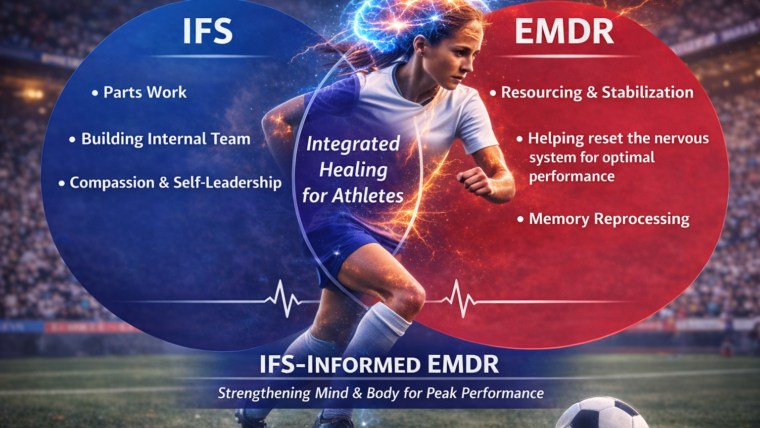
One athlete may benefit from improving recovery habits, strengthening emotional regulation, and expanding their window of tolerance—the range in which the nervous system can stay flexible, focused, and connected under pressure.
Another athlete may need help processing an unresolved experience.
As an EMDR therapist, I often work with both.
Sometimes our work focuses on building adaptive capacity by strengthening internal resources, improving stress tolerance, and helping athletes regulate more effectively under pressure.
Other times, we help the brain process experiences that have become “stuck,” allowing the nervous system to update those memories so they no longer trigger the same automatic responses.
The goal isn’t simply to reduce stress.
It’s to increase the nervous system’s capacity to adapt, recover, and perform.
A Different Way to Think About Performance
Perhaps the most important question isn’t whether an athlete has experienced stress or trauma.
It’s whether their nervous system has had the opportunity to recover and is additional support needed?
When we begin asking that question, we move beyond assumptions about toughness and toward a more compassionate, evidence-informed understanding of performance, resilience, and healing.
Because every athlete will experience adversity at some point.
Not every nervous system will experience it the same way.
And understanding that difference may be one of the most powerful ways we can better support athletes—both in sport and beyond.
Ultimately, athlete nervous system recovery isn’t about avoiding challenge. It’s about helping athletes process experiences, restore adaptability, and return to competition with greater confidence, resilience, and long-term well-being.