


Procedural memory in sports allows athletes to perform at their best when they trust their training. This article explores how stress, threat, and unresolved experiences can interrupt automatic movement and why even elite athletes can suddenly begin to hesitate or overthink. It also shows that strengthening flow state experiences help optimize peak performance.
Key Takeaways
- Procedural memory in sports allows athletes to perform complex skills automatically without consciously thinking through every movement.
- Stress, injury, trauma, repeated failure, and overwhelming pressure can interfere with access to these automatic movement patterns.
- When athletes begin consciously controlling skills that were once automatic, performance often becomes less fluid and less consistent.
- Performance challenges are not always mechanical; sometimes the nervous system responds to a perceived threat.
- Performance EMDR helps athletes strengthen peak performances and can also explore whether unresolved experiences may be contributing to performance disruptions while recognizing that technical coaching and physical rehabilitation remain essential when appropriate.
- Understanding how the nervous system influences performance can replace frustration with curiosity, opening the door to renewed confidence and more consistent execution.
Athletes spend countless hours developing movements that eventually become automatic. Procedural memory in sports enables those skills to be performed with remarkable speed and precision, often without conscious thought. Whether it’s a pitcher delivering a fastball, a gymnast completing a routine, or a golfer striking the perfect drive, elite performance depends on trusting training rather than consciously controlling every movement.
When Confidence Suddenly Disappears or Everything is in the Zone
Imagine a pitcher standing on the mound. He’s thrown this pitch thousands of times. His mechanics have been refined through years of practice, skills coaching, and technical development. He knows exactly what he wants to do.
But he throws a pitch over the catcher’s glove.
The next pitch misses even farther. Worse, it might hit his teammate or even bounce before reaching home plate.
Now he’s thinking about his elbow, his stride, his release point, and his breathing—trying to consciously control something that once happened effortlessly.
Another athlete is in the starting blocks waiting for the 100-meter sprint to start.
When the gun fires years of training to drive the arms, push off the block, keep the head down (all without thinking about technique) have been encoded into this explosive drive-phase of procedural memory.
In the zone experiences allow the athlete to experience the somatic, felt sense of explosive power. When the conscious mind steps out of the way, the nervous system executes on auto-pilot complex technique incredible fast. The same brain systems that create performance blocks are also the systems responsible for mastery.
What Is Procedural Memory in Sports?
Most people think of memory as remembering facts or recalling personal experiences.
However, athletic performance relies on a very different system known as procedural memory. First, it is helpful to understand declarative (explicit) memory which is what you can consciously remember and explain. Procedural memory is a form of (implicit) memory that allows skills to become automatic through repetition, without conscious awareness. Unlike explicit memory—which includes facts and events we can intentionally recall— this type of implicit memory (procedural) develops through doing.
This is what allows a baseball pitcher to throw with precision, a golfer to swing naturally, a gymnast to tumble confidently, or a quarterback to deliver an accurate pass while reading the defense in real time.
Years of deliberate practice gradually build automatic movement patterns. As a result, instead of consciously planning every motion, athletes can react quickly, efficiently, and instinctively.
At its best, procedural memory in sports allows performance to feel smooth, effortless, and fully connected to the moment.
When Stress Changes Procedural Memory in Sports
The nervous system is constantly evaluating both internal and external cues for signs of safety or danger. This ongoing process influences attention, emotional regulation, movement, and decision-making.
When the brain detects threat, protective responses begin competing with the systems responsible for fluid, automatic performance.
I’ve written previously about how nervous system regulation and state-dependent learning influence performance. Procedural memory adds another layer of complexity: understanding why a skill that has been automatic for a long time for an athlete or performer can suddenly become inaccessible.
Why Overthinking Disrupts Procedural Memory in Sports
When athletic performance suddenly changes, the natural response is often to focus on mechanics.
Sometimes that’s exactly the right solution.
However, when the underlying challenge involves a dysregulated nervous system, increasing conscious control over an automatic movement may unintentionally worsen performance.
Sport psychology researchers describe this phenomenon as reinvestment. Under pressure, athletes begin consciously monitoring movements that normally occur automatically. Consequently, attention shifts away from performing the skill and toward controlling every detail of the skill.
This often creates a frustrating cycle:
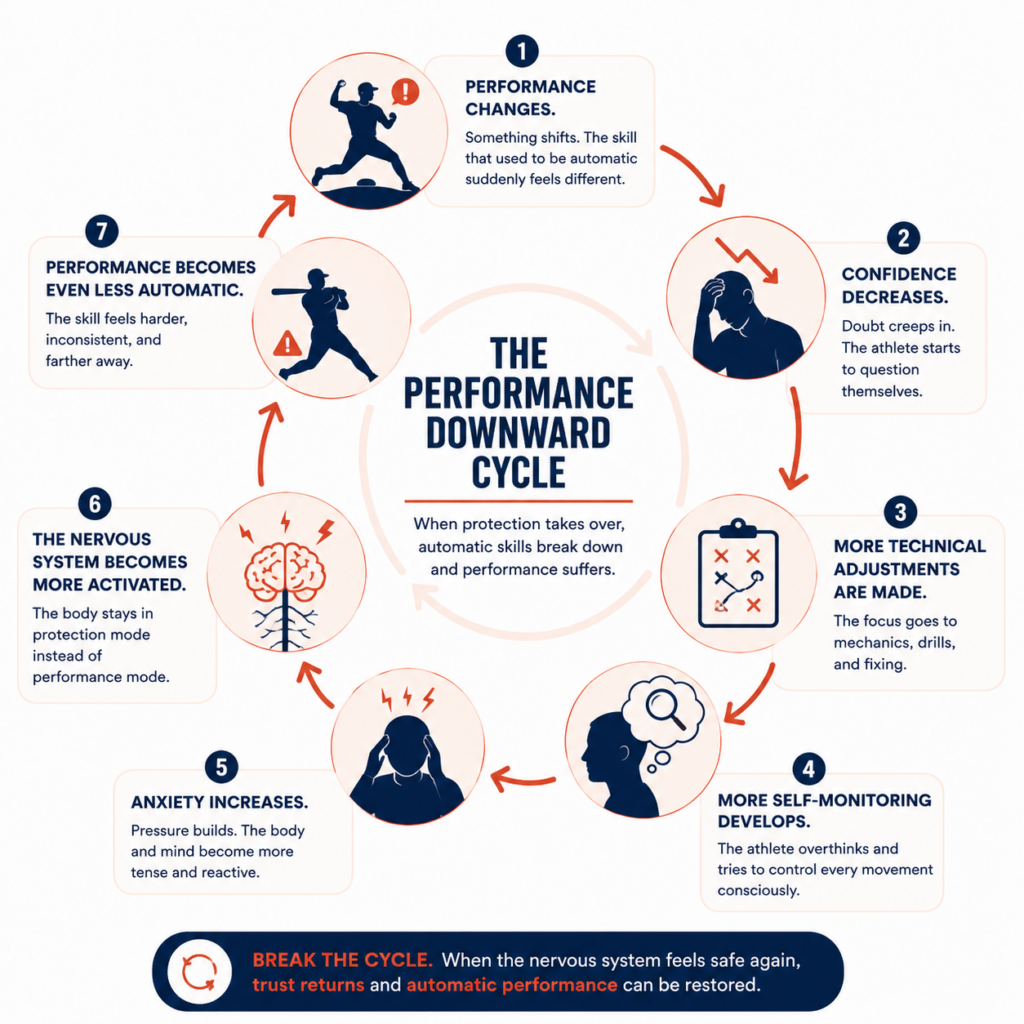
With each repetition, athletes may begin to trust their bodies a little less.
Ironically, the harder they try to consciously control their movement, the more difficult it becomes to access the automatic patterns that years of training have built.
How EMDR Looks Beyond Mechanics
Performance EMDR offers to help strengthen optimal performance states and then if need access further an athlete’s current performance disruption patterns by asking deeper questions that explore the athlete’s experience:
- What changed?
- When did performance begin to shift?
- Was there an injury?
- Did a significant mistake occur?
- Was there a coaching change?
- Was there a painful loss?
- Was there a public failure?
- Was there a period of overwhelming stress?
- Has the nervous system begun to associate this performance environment with danger rather than confidence?
Looking Beyond Technical Mechanics
These experiences do not always remain as conscious memories that athletes think about every day.
Instead, they sometimes leave lasting associations within memory networks, emotional learning systems, attention processes, and the nervous system itself. Those associations may continue influencing performance long after the original event has passed.
Rather than assuming every performance decline is technical, Performance EMDR recognizes that understanding an athlete’s story is just as important as understanding their mechanics. It considers whether unresolved experiences may be affecting the athlete’s ability to access well-established procedural skills.
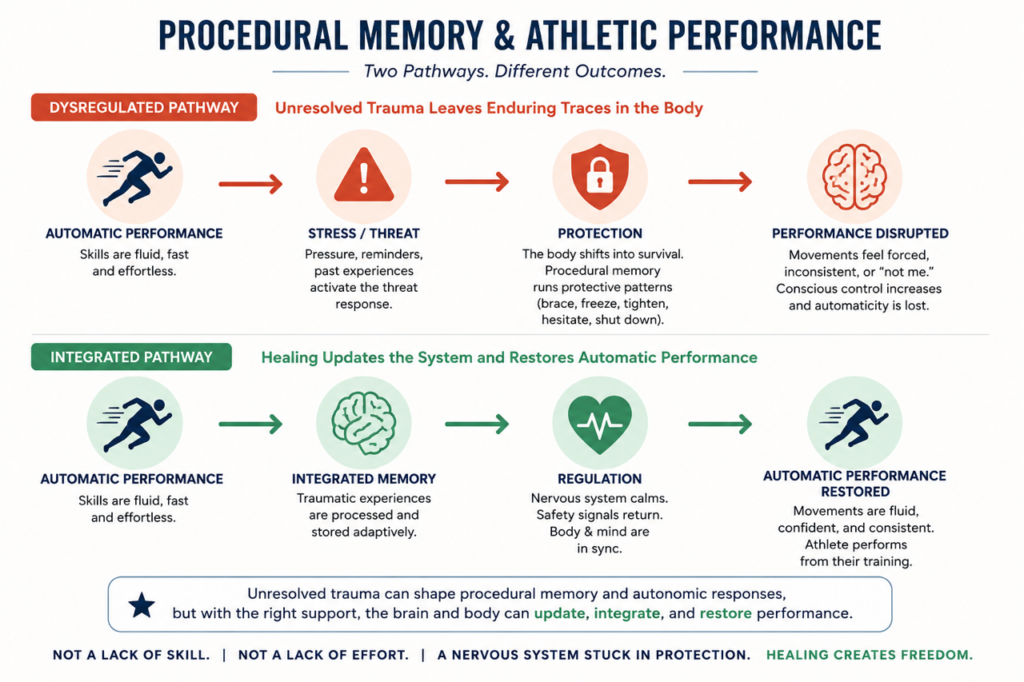
Brain Integration: Restoring Access to Procedural Memory in Sports
The work is to help the athlete regain access to the abilities they already possess—not just reduce symptoms or simply to strengthen the optimal felt-sense of flow state performances.
As a clinician working with athletes, it is energizing to witness the ways individuals often find hope, joy, self-compassion, and confidence as their brains integrate their lived experiences and to strengthen the positive experiences by focusing on the felt sense of confidence and competence in their sport.
One of the greatest privileges of my work is when I receive a text from an athlete sharing a breakthrough after practice or competition—or simply that they are doing well. These moments stay with me, and you won’t read about those stories here. Confidentiality is an important part of creating safety and connection. So instead, I share the themes, the patterns, and neuroscience- not the personal details through my writing and speaking.
Restoring Trust in Your Training
Ultimately, athletes spend years developing exceptional physical skills.
Sometimes those skills haven’t disappeared—they’ve simply become harder to access because the nervous system has shifted into a protective state.
Understanding procedural memory in sports reminds us that performance isn’t determined by talent alone. It is also influenced by the experiences our brains and bodies carry with us.
When we talk about an athlete in their flow state, their procedural memory is running the performance. However, if the nervous system detects a threat—a familiar smell, sound, environment, or a situation where the past experience feels as though it is happening in the present, which can easily occur during moments of high stress, evaluation, perceived judgment, or fear of failure—the survival response is triggered. When that happens, often control shifts away from the automatic, smooth motor pathways and back to the conscious, analytical brain, interrupting the “muscle memory” loop.
Yet we don’t have to wait for disruptions in performance. By working to strengthening the positive feedback loops performance EMDR is a powerful vehicle to actively process the optimal movement patterns deeper into the nervous system, offering a neural track that helps train the autonomic nervous system (ANS) to stay regulated during future moments of execution and to help prevent the amygdala from hijacking performance. The mental rehearsal of the peak performance lays the foundation.
Ultimately, when athletes understand that the physical experiences carried inside their bodies offer blueprints to be strengthened for peak performance- rather than problems to be fixed- it changes the work. If athletes are experiencing the yips, challenges returning from injury, or noticing performance changes under pressure, better understanding procedural memory offers hope in understanding that peak performance isn’t just about mechanics but also how the brain and nervous system access those mechanics.
Whether you are looking to unlock your optimal performance potential or need targeted integration support, a deeper partnership with your nervous system offers you a competitive edge.
Further Reading
- Larry Squire – Memory Systems of the Brain
- Sian Beilock – Choke
- Masters & Maxwell – The Theory of Reinvestment
- Bessel van der Kolk – The Body Keeps the Score
- Francine Shapiro – EMDR Therapy (3rd ed.)