


Athletes don’t perform solely from what they know—they perform from what their brain has learned to access automatically under pressure.
Understanding implicit memory in athletes can help explain why the body sometimes reacts before the conscious mind understands what is happening. Memory influences how athletes learn skills, respond under pressure, recover from setbacks, and access the automatic abilities they have spent years developing.
Key Takeaways
- Explicit memory includes facts and experiences athletes can consciously recall and describe.
- Implicit memory influences automatic skills, emotional responses, physical sensations, and learned reactions outside conscious awareness.
- An athlete can consciously know they are safe or capable while their nervous system responds differently.
- Previous injuries, mistakes, and high-pressure experiences may create implicit associations that influence present performance.
- Understanding how memory works may help athletes strengthen resilience, recovery, confidence, and access to peak performance states.
Understanding Memory and Athletic Performance
Have you ever considered that understanding memory can improve performance?
Athletes commit large chunks of time to training their bodies for optimal conditioning. But I wonder how much time is spent understanding one of the most important learning systems we have—memory.
Memory isn’t just about recalling yesterday’s practice or remembering a coach’s game plan. It’s how the brain learns skills, recognizes patterns, predicts what’s likely to happen next, and helps us adapt under pressure.
The more we understand how memory works, the better equipped we are to strengthen performance, build resilience, and recover from setbacks.
If you have sensed a theme in my writing this summer—or if you are just joining me—I’ll catch you up. It has been a Summer of Remembering.
From Men’s Mental Health Month in June to World Cup memories in July, we have been exploring the intersection of neuroscience, performance, and trauma-informed care.
This all leads to my present blog series on memory.
I realized that those reflections express something I often share with athletes and high performers: psychoeducation about memory. It’s not just the stories we can tell. The memories our nervous system carries outside conscious awareness can also influence our health, growth, and performance.
What If Healing Is About Remembering Differently?
As I’ve been writing about remembering this summer and exploring how our experiences continue to shape us, a dinner conversation this week about Christopher Nolan’s new Odyssey film sparked another thought.
In the film, Odysseus is given lotus flowers that ease the pain of memory, but in forgetting, he also begins to lose himself.
Whether viewed as mythology or metaphor, it raises a fascinating question:
What if healing isn’t about forgetting at all? What if it’s about remembering differently?
The story isn’t neuroscience, of course. But it captures something many athletes experience.
We often wish we could simply forget painful moments—a devastating injury, a missed shot, a season-ending loss. Yet our brains and bodies don’t necessarily work that way.
Even when we can’t consciously recall an experience, our nervous system may still carry aspects of what it learned from that experience.
Last week, I wrote about procedural memory—the remarkable ability of the brain and body to perform skills automatically after years of practice.
But procedural memory is only one piece of a much larger picture. It is a subcategory of implicit memory.
Not all memories are stored—or experienced—the same way.
Explicit vs. Implicit Memory in Athletes
One of the most helpful distinctions in understanding memory and athletic performance is the difference between explicit memory and implicit memory.
These two memory systems help explain something athletes frequently experience: the difference between consciously knowing something and automatically responding to it.
An athlete may know they have recovered from an injury, know they have successfully performed a skill thousands of times, or know exactly what their coach wants them to do.
Yet under certain conditions, their body may respond differently.
Understanding explicit and implicit memory can change how we think about confidence, performance under pressure, injury recovery, why some athletes feel “stuck,” and how athletes may strengthen access to peak performance states.
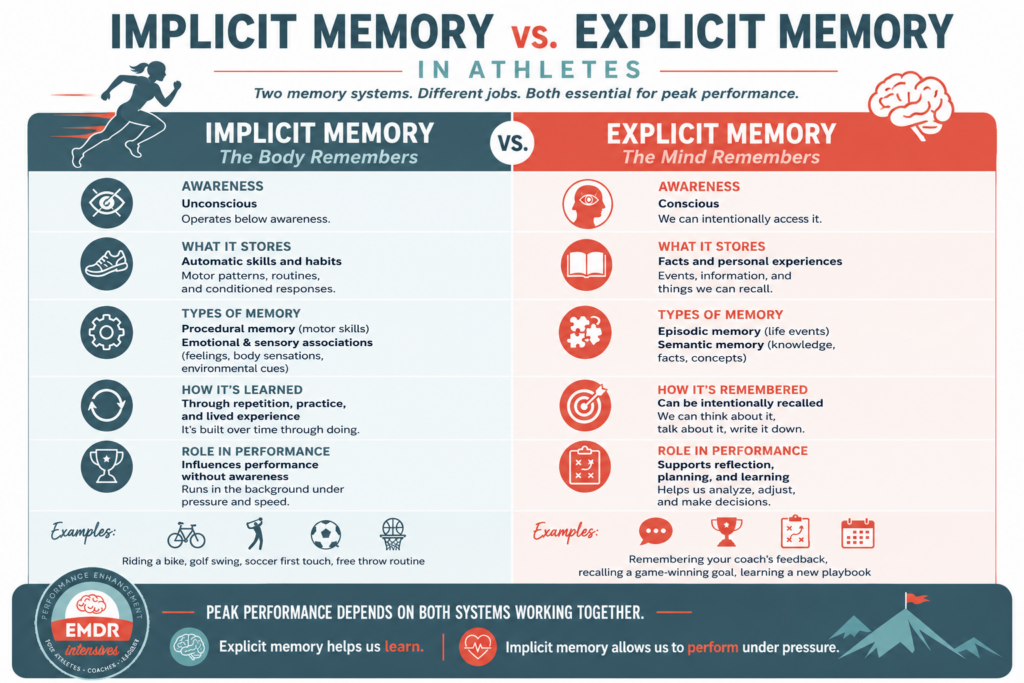
Explicit Memory: The Memories You Can Describe
Explicit memory, sometimes called declarative memory, includes memories we can consciously recall and talk about. This type of memory relies heavily on brain regions including the hippocampus and prefrontal cortex.
Examples include:
- The score of last year’s championship game.
- Your coach’s pregame speech.
- The date you committed to college.
- The strategy discussed during halftime.
- Remembering the route for tomorrow’s race.
These memories are accessible through conscious thought.
When your friend asks:
“What did you do this weekend?”
Explicit memory helps you answer.
In sport, explicit memory allows athletes to consciously recall instructions, strategies, past experiences, and information they have learned.
But conscious knowledge is only part of what influences performance.
Implicit Memory: The Memories You Experience Without Thinking
Implicit memory is different.
These memories influence us without requiring conscious awareness. Different forms of implicit memory involve brain systems including the amygdala, basal ganglia, and cerebellum.
Examples include:
- Riding a bicycle.
- Returning a tennis serve.
- Automatically adjusting your stride on uneven terrain.
- Catching a ball without calculating its trajectory.
- Feeling your body tense when entering the gym where you were injured.
Often, athletes don’t realize implicit memory is influencing them until they notice their body reacting before their mind understands why.
They may experience tightness in the chest, shortness of breath, muscle tension, hesitation, or a feeling that the body has suddenly become heavy.
This is one reason implicit memory in athletes can be so important to understand.
An athlete may consciously know one thing while the nervous system has learned something very different from a previous experience.
Your Body Often Knows Before Your Mind Does
Have you ever walked into a stadium and immediately felt nervous?
Or returned to the field where you suffered an injury and noticed your heart rate increase before the game even began?
This may reflect how your body is adaptively working to protect you.
The brain constantly links experiences with emotions, sensations, and predictions about what might happen next.
Often, before we consciously analyze a situation, our nervous system has already begun preparing a response.
This ability is incredibly useful.
Athletes depend on rapid, automatic responses every day. There simply isn’t enough time to consciously calculate every movement during competition.
But the same learning system that helps an athlete react automatically can also associate certain situations with danger, failure, pain, or threat.
That distinction becomes especially important when an athlete returns to competition after a difficult experience.
A Soccer Example
Imagine a goalkeeper who misjudges a cross during a championship match.
Months later, she remembers the event clearly, possibly with tactical insight.
That’s explicit memory.
But every time another high ball comes into the box, she hesitates for just a fraction of a second.
She isn’t choosing to hesitate. It might be that her brain has associated that situation with threat.
That’s implicit memory influencing performance.
Consciously, she may understand exactly what went wrong and what she needs to do differently.
Her nervous system, however, may still be responding based on what it learned during the earlier experience.
That fraction of a second matters.
At an elite level, performance often depends on automatic reactions happening without hesitation.
A Runner’s Example
A trail runner suffers a severe fall on a rocky descent.
The fracture heals, and he is cleared to run again, knowing he is healthy.
That’s explicit knowledge.
Yet each time he runs again on technical downhill terrain, his breathing changes, muscles tighten, and confidence disappears. Thoughts might start racing.
Nothing is necessarily wrong in the present moment, but his nervous system could still be responding based on learning associated with the earlier experience.
His conscious mind knows the injury has healed.
His body may still be predicting danger.
This difference between what an athlete consciously knows and what the nervous system has implicitly learned can help explain why simply telling someone to “trust yourself,” “stop thinking about it,” or “just be confident” may not always change the response.
Why Implicit Memory Matters in Athletic Performance
Many performance challenges don’t stem from a lack of motivation or effort.
Sometimes athletes know exactly what they want to do.
Their body simply isn’t responding the way they expect.
This is where understanding explicit and implicit memory becomes especially useful.
Explicit instructions don’t always change implicit learning.
An athlete may understand the mechanics of a movement perfectly. They may have practiced it thousands of times. Their coach may repeatedly reassure them that they are ready.
Yet when a specific situation activates an older learned response, hesitation, tension, overthinking, or physiological arousal may appear.
Rather than viewing these reactions only as a failure of confidence or mental toughness, we can become curious about what the brain and nervous system may have learned.
That shift can open new possibilities for both performance training and therapeutic work.
Where Therapy and Training Meet
One of the exciting developments in neuroscience is recognizing that memory isn’t fixed.
Our brains continue updating experiences throughout life.
Approaches such as nervous system regulation informed by polyvagal theory, biofeedback, heart rate variability training, and therapies like EMDR (Eye Movement Desensitization and Reprocessing) and IFS (Internal Family Systems) all aim—in different ways—to help people build more adaptive responses to experiences.
The goal isn’t to erase memories.
Through processes associated with memory reconsolidation, neural networks can be updated.
The factual event is not changed. The athlete still knows what happened—that is part of explicit memory.
What may shift is the implicit target: the threat-based association connected with the experience.
The goal is to help uncouple an old threat response from the present moment, reducing physiological reactivity so athletes can more readily access their natural flow, resilience, confidence, and skill.
For athletes whose performance challenges seem disconnected from what they consciously know they can do, understanding this distinction may be especially valuable.
The Takeaway: Memory, the Nervous System, and Performance
Athletes often ask:
“If I know I can do it, why can’t I do it when it matters most?”
Part of the answer may lie in understanding that the brain stores and processes different kinds of memories.
Explicit memory allows us to consciously remember facts and experiences.
Implicit memory shapes automatic skills and how our body responds—often before we’re even aware it’s happening.
Recognizing that difference is an important first step toward understanding how memory, the nervous system, and athletic performance are deeply connected.
It may also help us approach performance struggles differently.
Instead of assuming an athlete simply needs more motivation, more confidence, or more practice, we can ask a different question:
What has the athlete’s brain and nervous system learned from previous experiences, and is that learning still useful in the present moment?
The brain isn’t simply a source of problems to fix—it’s an extraordinary system designed to learn, adapt, protect, and grow. By understanding how it works, athletes can intentionally build the conditions for both high performance and long-term well-being.
Looking Ahead: How Memory Networks Shape Performance
Next week, we’ll explore another fascinating question:
Why does one mistake sometimes trigger a cascade of self-doubt while another rolls right off our backs?
The answer may lie in how the brain connects experiences into memory networks.