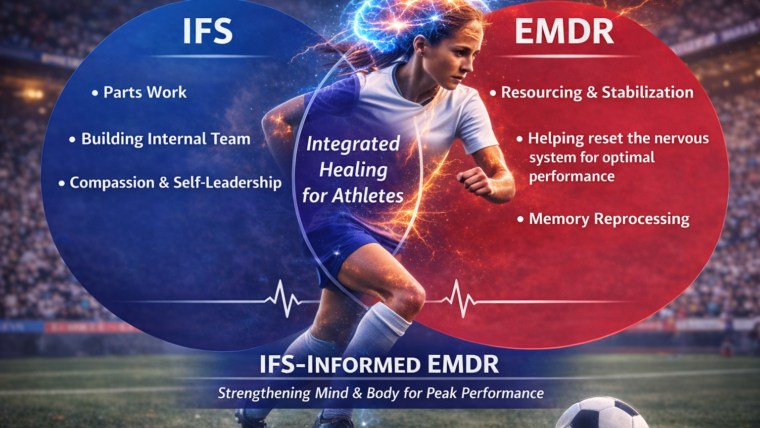


Key Takeaways
- Injury recovery is not only physical; the nervous system plays a central role.
- Even after physical healing in the body, the brain may continue to register a threat.
- EMDR therapy is a bottom-up approach that can help treat unresolved injury-related threat responses.
- Nervous system regulation supports confidence, fluid movement, and optimal athletic performance.
Injury Recovery for Athletes Is More Than Physical Healing
Injury recovery for athletes is not only about physical healing. The nervous system plays a critical role in how confidently and safely an athlete returns to training and competition.
Recently, I spoke with an athletic trainer about injuries and recovery. We discussed an often-overlooked piece of the return-to-sport process: the nervous system.
Many athletes who have been medically cleared still feel hesitant, anxious, or something still feels “off.” They may be working hard in rehab, strength training, and mental skills training, yet something does not click. It can feel like pushing and pulling at the same time—exerting effort without making forward progress. This often leads to confusion and frustration, which can impact an athlete’s motivation. The lack of change is not a lack of grit or discipline. It is frequently a nervous system issue.
Sports injuries are not just an event that happens to the body; they are an experience that the brain encodes along with important information; the physical pain, the emotional intensity, the context of the event and the perception of threat. Sometimes later when an athlete is in a similar situation; for example, landing, sprinting, moving with a cut, the brain might flag that as “potentially dangerous”.
How the Nervous System Affects Injury Recovery for Athletes
When an injury occurs, the brain may encode the event as a threat. This is adaptive and protective. The level of perceived threat influences future responses. So, even after the body heals, the nervous system may remain in protective mode. This is adaptive and meant to prevent more harm.
Common signs include:
- Hesitation before specific movements
- Tightness or loss of fluidity
- Fear of re-injury
- Racing heart or shortness of breath during return to play
- Feeling frozen, disconnected, or mentally overwhelmed
- Anxiety or panic
These responses can reflect the nervous system activation of the body’s protective stress response.
Encouragement such as “trust your body” or “don’t think about it” is rarely sufficient. The brainstem and midbrain activate faster than conscious thought. If the nervous system still senses danger—real or perceived—it will override intention.
This is why athletes cannot simply “think” their way out of it. Attempting to push through can even increase the risk of re-injury if the body shifts into freeze or hyperarousal states.
I often share with clients that fear is not just “in their head,” but it can influence their performance and movement patterns. Research in sports medicine shows that fear of reinjury is a leading factor in delayed return to sport. Curious for more research- check out references below.
EMDR Therapy in Injury Recovery for Athletes
“Bottom-up” approaches address the nervous system directly. One evidence-based method is Eye Movement Desensitization and Reprocessing (EMDR) therapy.
EMDR therapy helps the brain metabolize distressing memories or injury-related experiences so they no longer trigger a threat response. Rather than teaching coping skills alone, EMDR works to resolve the underlying activation that is no longer necessary for protection.
It is important to note:
- Many athletes recover naturally as physical healing progresses.
- Not all injured athletes require additional psychological support.
- For those who remain stuck, EMDR can be a powerful adjunct to rehabilitation.
Emerging research in injured athletes shows improved confidence and reduced anxiety during the return-to-sport process when nervous system-focused interventions are included.
Restoring Confidence Through Nervous System Regulation
When injury recovery for athletes includes nervous system regulation, performance returns with greater stability and confidence, and athletes often report:
- Less overthinking
- Greater trust in their bodies
- More fluid and automatic movement
- Improved mood and emotional stability
Healing the brain-body connection supports both mental health and athletic performance. It strengthens protective factors such as re-engaging in training, traveling with teammates, and participating fully in competition.
If you or someone you know feels stuck in injury recovery despite “doing everything right,” the next step may not be more mental toughness. It may be nervous system regulation.
When recovery is embodied rather than forced, athletes do more than return. They thrive.
- Trenhaile, J., Trenhaile, T., & Munce, T. (2025). Pilot study of the efficacy of EMDR intervention for injured Division I student-athletes.
- Reynoso-Sánchez, L. F., & Hoyos-Flores, J. R. (2023). EMDR therapy reduces anxiety and improves self-confidence in athletes with post-injury trauma.
- Ardern et al., 2013 – Fear of reinjury and return to sport after ACL reconstruction
- Chmielewski et al., 2008 – Psychological factors in ACL recovery
- Paterno et al., 2018 – Psychological readiness and reinjury risk