

Summary: Why Play Circuitry and EMDR Therapy Matter
- Play circuitry and EMDR therapy helps the nervous system stay regulated during difficult processing.
- Play activates neuroplasticity and emotional flexibility.
- Nervous system regulation determines learning and performance.
- Athletes heal and perform better when the challenge includes safety.
- Play is a biological state, not the opposite of discipline or performance.
Play Circuitry, EMDR Therapy and Performance
I’ve been reflecting on this after a recent Huberman Lab episode where Andrew Huberman discussed play circuitry and its role in learning and neuroplasticity across the lifespan, drawing on the work of affective neuroscientist Jaak Panksepp. I came across his work over a decade ago in a training, and it has deeply influenced my work as an EMDR clinician.
The core idea is simple but powerful:
Play creates low-consequence environments where the brain learns best.
Play circuitry and EMDR therapy may be some of the most overlooked mechanisms in both healing and performance work.
Think about the best training sessions you’ve ever experienced, coached or seen. You or the athlete was:
- Focused, but not tight
- Challenged, but not overwhelmed
- Able to make mistakes without feeling fearful
That is, play circuitry online.
When stress rises—pressure, fear of failure, overthinking—the nervous system shifts into survival mode. Learning narrows. Creativity drops. Adaptation slows.
But when play circuitry is activated, the brain becomes more flexible. Neuroplasticity increases. The system can update patterns instead of reinforcing fear.
That’s why understanding play circuitry and EMDR therapy changes how we think about both trauma work and performance psychology.
What Is Play Circuitry?
From a neuroscience perspective, play is not simply a mindset. It is a nervous system state driven by subcortical systems in the midbrain and brainstem.
Research in affective neuroscience shows that play supports:
- Exploratory learning
- Social engagement
- Emotional flexibility
- Adaptive responding under stress
When play circuitry is online, learning accelerates. When it is offline, the nervous system becomes defensive.
In performance environments, this difference is everything.
Play Circuitry, EMDR Therapy and Nervous System Regulation
This is one of the reasons I love being an EMDR therapist. There’s both an art and a science to the work.
In approaches like EMDR 2.0, we intentionally tax working memory (while a disturbing memory has initial been accessed, for example a moment of injury, a freeze response that shows up as the yips, a moment of public failure with shame or humiliation, or any other disturbing sports or life event) and then using tasks like:
- Eye movements
- Mental math
- Pattern tracking
- Spelling words forward and backward
The goal is to integrate stuck memory networks.
And something often happens:
There is focus.
There is a challenge.
And often… There is laughter. Spelling backwards is hard for most people!
That laughter is not avoidance. It is often a sign that play circuitry is active while trauma processing is occurring. Play happens when the fear and panic circuits are offline and there is the state of neuroception of safety. Remember the nervous system is always scanning for safety and connection below conscious awareness. Play is like a workout for the front of the brain teaching the executive centers how to regulate the impulsive, emotion centers.
When safety, novelty, and engagement coexist, the nervous system can process difficulty without becoming overwhelmed. This is where EMDR therapy becomes powerful for athletes.
Play Circuitry, the Ventral Vagal State, and Learning
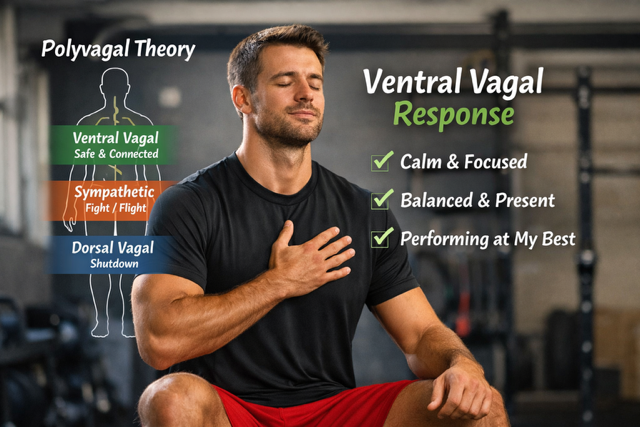
Through Polyvagal Theory, play aligns with the ventral vagal state—the physiological state of safety and connection.
In this regulated state:
- Attention broadens
- Mistakes feel informative rather than threatening
- Learning consolidates more efficiently
When the system shifts into fight-or-flight, performance may continue, but creativity narrows. When shutdown occurs, play disappears entirely.
Play circuitry in EMDR therapy helps maintain sufficient regulation so processing can continue without triggering overwhelm.
This is nervous system flexibility in action.
What This Means for Athletes and Coaches
The best training environments:
- Balance challenge with psychological safety
- Encourage experimentation
- Allow mistakes without catastrophic meaning
EMDR therapy mirrors this structure.
When athletes understand therapy as nervous system training—not weakness—they become more open to the process. It often becomes far less intimidating—and far more effective.
This is trauma-informed performance care.
EMDR therapy allows athletes to face difficult memories while remaining engaged instead of shutting down. It’s not about avoiding hard things—it’s about training the nervous system to stay engaged while facing them.
Why This Matters
Play is not the opposite of discipline or performance.
Play is a biological mechanism that supports:
- Neuroplasticity
- Emotional resilience
- Adaptation under pressure
- Long-term growth across the lifespan
Sometimes the most powerful change happens when the work doesn’t feel like work at all.
Bibliography
- Huberman, A. D. (2023). Huberman Lab Podcast (Episodes on play, learning, and neuroplasticity).
- Matthijssen, S. J. M. A., et al. (2021). The effects of working memory taxation on EMDR therapy: A meta-analysis. Journal of Anxiety Disorders, 77, 102326.
- Panksepp, J. (1998). Affective neuroscience: The foundations of human and animal emotions. Oxford University Press.
- Panksepp, J., & Biven, L. (2012). The archaeology of mind: Neuroevolutionary origins of human emotions. W. W. Norton & Company.
- Porges, S. W. (2011). The polyvagal theory: Neurophysiological foundations of emotions, attachment, communication, and self-regulation. W. W. Norton & Company.
- Porges, S. W. (2017). The pocket guide to the polyvagal theory. W. W. Norton & Company.
- Shapiro, F. (2018). Eye movement desensitization and reprocessing (EMDR) therapy: Basic principles, protocols, and procedures (3rd ed.). Guilford Press.
- Pellis, S. M., & Pellis, V. C. (2009). The Playful Brain: Venturing to the Limits of Neuroscience. Oneworld Publications.