
Key Takeaways
- A Sports Performance EMDR Intensive helps athletes process unresolved experiences that may still affect confidence and performance.
- EMDR therapy for athletes can support recovery from performance anxiety, the yips, injury fear, perfectionism, and self-doubt.
- The goal is not to erase memories but to help the nervous system stop reacting as if the past is still happening.
- Sports Performance EMDR Intensives combine nervous system regulation, performance enhancement, and trauma-informed care.
- Athletes often leave feeling calmer, lighter, more adaptable, and more connected to themselves.
- EMDR does not require retelling every painful detail of past experiences.
- Performance growth often becomes a natural byproduct of nervous system healing.
Many athletes, coaches, and high performers search for ways to overcome mental blocks, performance anxiety, injury fear, and the yips. A Sports Performance EMDR Intensive creates a focused space to help athletes process unresolved experiences, regulate their nervous systems, and reconnect with confidence, adaptability, and peak performance.
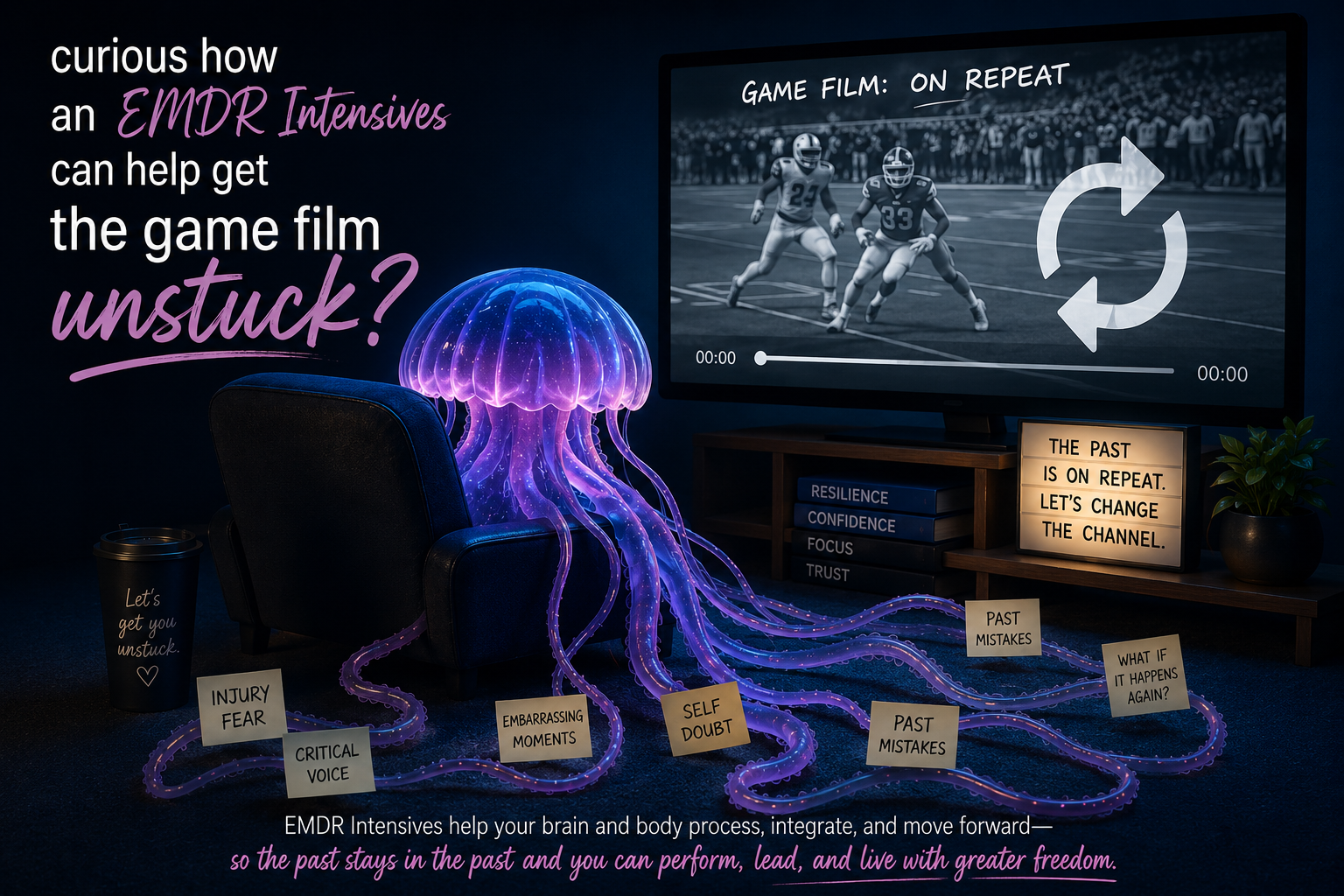
We don’t have to watch every game film from your life. We want to find the key plays that are still being repeated.
One of the most common questions I hear is:
“What actually happens during an EMDR Intensive?”
It’s a great question.
Many athletes and leaders know they feel stuck. They may be dealing with performance anxiety, loss of confidence, fear after injury, perfectionism, overthinking, or inconsistent performances.
They know something is getting in the way, but they are not always sure what it is.
A Sports Performance EMDR Intensive provides dedicated time and space to identify and process experiences that may still be affecting performance, leadership, confidence, and well-being.
Why An Intensive?
For many athletes and high performers, life rarely slows down.
Training schedules, travel, competitions, coaching responsibilities, work demands, and family commitments can make deeper therapeutic work difficult through traditional weekly sessions.
A Sports Performance EMDR Intensive allows athletes to step away from daily demands and focus deeply on healing, nervous system regulation, and performance growth.
Rather than spreading the work over several months, we use a concentrated period to identify and process experiences that may be keeping the nervous system stuck. I often describe it as helping the brain’s natural processing system reboot so the game film is no longer stuck on repeat.
The goal is not simply symptom reduction. The goal is greater freedom, adaptability, emotional resilience, and confidence.
For additional information about EMDR therapy research, visit EMDRIA.
What Happens During a Sports Performance EMDR Intensive
I personally enjoy every stage of the process, but the beginning of an intensive is often especially rewarding because EMDR is inherently strengths-based.
The treatment framework assumes that people already possess the natural ability to heal, adapt, and integrate experiences. I often explain that the problem is not a lack of resilience or mental toughness. Instead, certain experiences have become maladaptively stored, preventing the brain’s natural processing system from working effectively.
The brain is meant to watch the film, learn from it, and store it appropriately. But when emotionally intense experiences become stuck, the body and brain can begin reacting as though the past is still happening in the present.
This creates confusion, frustration, anxiety, and emotional reactivity that interfere with both performance and well-being.
Contrary to what many people assume, we do not jump directly into painful memories. We want athletes to be informed by past experiences, not controlled by them.
Before deeper reprocessing begins, we focus on strengthening adaptive resources and nervous system stability.
Sports Performance EMDR Intensive and Nervous System Healing
The first phase of the intensive focuses on creating safety, clarifying goals, and preparing the nervous system.
We discuss how EMDR therapy works and how certain experiences can remain “stuck” in the nervous system.
We also begin building tools and internal resources that support healing and performance enhancement.
This may include:
- HeartMath and coherence techniques
- Nervous system regulation skills
- Visualization exercises
- Safe or calm place resources
- Best performance memories
- Grounding strategies
- Mental container
Many athletes are surprised to discover that some of their greatest strengths already exist within them.
Part of the process involves strengthening adaptive neural networks so they become more accessible under pressure. We work to reinforce the emotional, physiological, and mental states associated with confidence, resilience, trust, and peak performance.
Athletes interested in nervous system regulation and mental performance may also benefit from reading more about performance anxiety in sports and sports trauma recovery.
Understanding the Team Within
I often integrate concepts from Internal Family Systems (IFS) to help clients better understand different parts of themselves.
For example, there may be:
- A critical part trying to prevent mistakes
- A perfectionistic part pushing for success
- A protective part avoiding risk
- A younger part carrying old hurts or disappointments
Rather than trying to silence these parts, we become curious about them.
Often, the very parts creating frustration today originally developed to help us survive, perform, or belong.
Understanding their role can create compassion and open the door to meaningful change.
For athletes and leaders, this shift can reduce inner conflict and improve emotional flexibility during high-pressure situations.
How EMDR Helps Athletes Process Performance Blocks
As the intensive progresses, we begin identifying experiences that may still be influencing current performance.
These experiences are not always obvious.
Sometimes they involve:
- Significant injuries
- Difficult coaching experiences
- Public mistakes or embarrassing moments
- Harsh criticism
- Performance failures
- Experiences of exclusion or rejection
- Developmental or attachment wounds
Many athletes assume they should simply “get over” these experiences.
But when experiences remain unprocessed, the nervous system may continue reacting as though the event is still happening.
This can show up as:
- The yips
- Anxiety
- Hesitation
- Loss of confidence
- Perfectionism
- Overthinking
- Difficulty trusting oneself
A Sports Performance EMDR Intensive helps athletes identify and process the experiences underlying these symptoms, rather than simply managing surface-level reactions.
The American Psychological Association also highlights the importance of mental health support for performance and emotional well-being.
The Reprocessing Work
This is where EMDR becomes incredibly powerful.
One common misconception is that EMDR therapy requires someone to tell a detailed trauma story.
It doesn’t.
Clients can share as much or as little as they choose.
The goal is not repeatedly retelling the story. The goal is to help the brain and nervous system process and integrate experiences that have become stuck.
As we identify memories, emotions, bodily sensations, and beliefs connected to those experiences, the brain begins to do what it naturally wants to do: heal.
The memory remains.
The lessons remain.
But the emotional charge often changes.
Instead of feeling controlled by the past, people begin feeling informed by it.
This shift can create meaningful changes in confidence, emotional regulation, focus, and consistency under pressure.
Sports Performance EMDR Intensive for Confidence Recovery
I’ve worked with athletes who discovered that their fear of re-injury wasn’t simply about the injury itself. What started as an adaptive protective response in the body had become stuck and no longer supported their current needs. The negative belief connected to the injury might be related to other life experiences, and it just got “stuck.”
Once the experience became fully processed, the body could begin responding to what was happening now rather than reacting to what happened then, and their beliefs about the experience and their core beliefs shifted.
I’ve worked with performers whose anxiety traced back to moments of embarrassment, criticism, or feeling they were not enough. Those emotionally intense moments were sometimes being reactivated in the present without conscious awareness.
I’ve also worked with high achievers who realized their inner critic was not an enemy, but a protector that had been working overtime for years and often helped them achieve their goals.
As these experiences become integrated, people often report feeling:
- Lighter
- Calmer
- More confident
- More emotionally flexible
- More connected to themselves
Not because they learned to “think positively,” but because their nervous system no longer has to stay stuck in old experiences.
As a result, beliefs often shift naturally from:
“I am a failure.”
to
“I am enough.”
The Athlete Before the Performer
One of my core beliefs is that the best performance work begins with the person, not the performer.
When we help the nervous system feel safe, process unresolved experiences, and reconnect with internal strengths, performance often improves as a natural byproduct.
Athletes frequently tell me they feel:
- More present
- More adaptable
- More grounded
- More trusting of themselves
After completing intensive work.
This is why EMDR therapy for athletes is not simply about reducing symptoms. It is about creating conditions for sustainable growth, resilience, and emotional well-being.
The Goal of a Sports Performance EMDR Intensive
A Sports Performance EMDR Intensive is not a magic wand.
But it can be a powerful catalyst.
It provides the time, structure, and support to address experiences that may be influencing performance, leadership, confidence, relationships, and overall well-being.
For athletes, coaches, and leaders who feel stuck—or who simply want to perform and live with greater freedom—an intensive can create an opportunity to reset, heal, and move forward with greater clarity and confidence.
The goal is not to erase the past.
The goal is to help the past stay in the past so you can fully engage with the present and move confidently toward the future.
For many athletes and leaders, a Sports Performance EMDR Intensive becomes a turning point toward greater confidence, emotional flexibility, and freedom under pressure. Performance enhancement is often not about adding more and more mental skills. Often it is about removing the barriers that prevent the athlete, coach or leader from accessing the skills they already possess.
Still curious? Read on; the FAQ gives more insights.
Frequently Asked Questions About EMDR Intensives
Will I have to talk about everything that happened?
No. One unique aspect of EMDR is that you do not have to share every detail of an experience for healing to occur. You can share as much or as little as feels comfortable. The focus is not on repeatedly retelling the story but on helping your brain and nervous system process and integrate the experience.
What if I’m worried about becoming overwhelmed by emotions?
This is one of the most common concerns people have before an intensive. Preparation is a significant part of the process. Before we begin deeper reprocessing work, we build resources and regulation skills to help you stay grounded. Throughout the intensive, we continually monitor your nervous system and adjust the pace as needed. The goal is not to flood you with emotions but to help you process experiences in a way that feels manageable and effective.
I like to share the example of eating: we’re going to cut the food into bite-sized pieces to help with digestion—the same is true with experiences involving intense emotions, sensory fragments, sounds, images, body sensations, and smells.
How many memories or experiences do you typically work on during an intensive?
This is one of my favorite questions but one I am not often asked. The honest answer is: it depends.
Every person comes with a unique history, current concerns, goals, and nervous system. Some people may focus on a few key experiences, while others may benefit from working through a broader range of memories connected to a specific theme.
One reason EMDR can be such an efficient treatment is that we do not necessarily have to process every difficult experience individually.
I often use the example of a jellyfish. If we can identify and process the core experiences that form the body of the jellyfish, many of the feeder memories connected to those experiences—the tentacles—often begin to shift as well.
For example, an athlete may have dozens of memories involving humiliation, public failure, criticism, or a lack of confidence. Rather than processing every single memory, we look for a few key experiences that helped shape those reactions, beliefs, and nervous system responses.
As those core memories become integrated, many related memories naturally lose their emotional intensity and influence.
How is an intensive different from weekly therapy?
An intensive creates dedicated time and space for deeper work without the interruptions of daily life. Rather than spending months moving through the process in weekly sessions, we can often make significant progress over several consecutive days. Many athletes, coaches, and leaders appreciate being able to focus fully on healing and growth before returning to training, competition, or professional responsibilities.
Is an EMDR Intensive only for trauma?
Not at all. While EMDR is well known for treating trauma, it can also help address experiences connected to performance anxiety, the yips, fear of failure, loss of confidence, perfectionism, injury recovery challenges, self-doubt, and other obstacles that interfere with performance and well-being.
What if I don’t know what’s causing my struggles?
That’s okay. Many people arrive knowing what they’re experiencing but not why. Part of the intensive process involves identifying patterns, experiences, beliefs, and nervous system responses that may be contributing to current challenges.
How do I know if an EMDR Intensive is right for me?
EMDR Intensives can be a good fit for athletes, coaches, and leaders who are looking for focused, accelerated work and are ready to dedicate time to healing, growth, and performance goals.
During a consultation, we can determine whether an intensive is the best fit for your needs and goals.