


Summary
- Athlete memory networks connect present experiences with emotionally similar past events.
- Two athletes can respond very differently to the exact same mistake.
- Memory networks shape confidence, self-doubt, and performance under pressure.
- Negative networks are not permanent—they can change.
- EMDR helps athletes process unhelpful networks while strengthening adaptive ones.
Two athletes miss the same shot.
One shrugs it off.
The other can’t stop thinking about it for days.
Why?
That was the question I left you with at the end of last week’s discussion about explicit and implicit memory.
The answer may not lie in the mistake itself.
Instead, it may lie in something called athlete memory networks—the way our brains connect experiences that share similar emotions, meanings, body sensations, beliefs, and physiological states.
Our brains don’t store experiences like neatly labeled folders.
Instead, they organize them into interconnected networks.
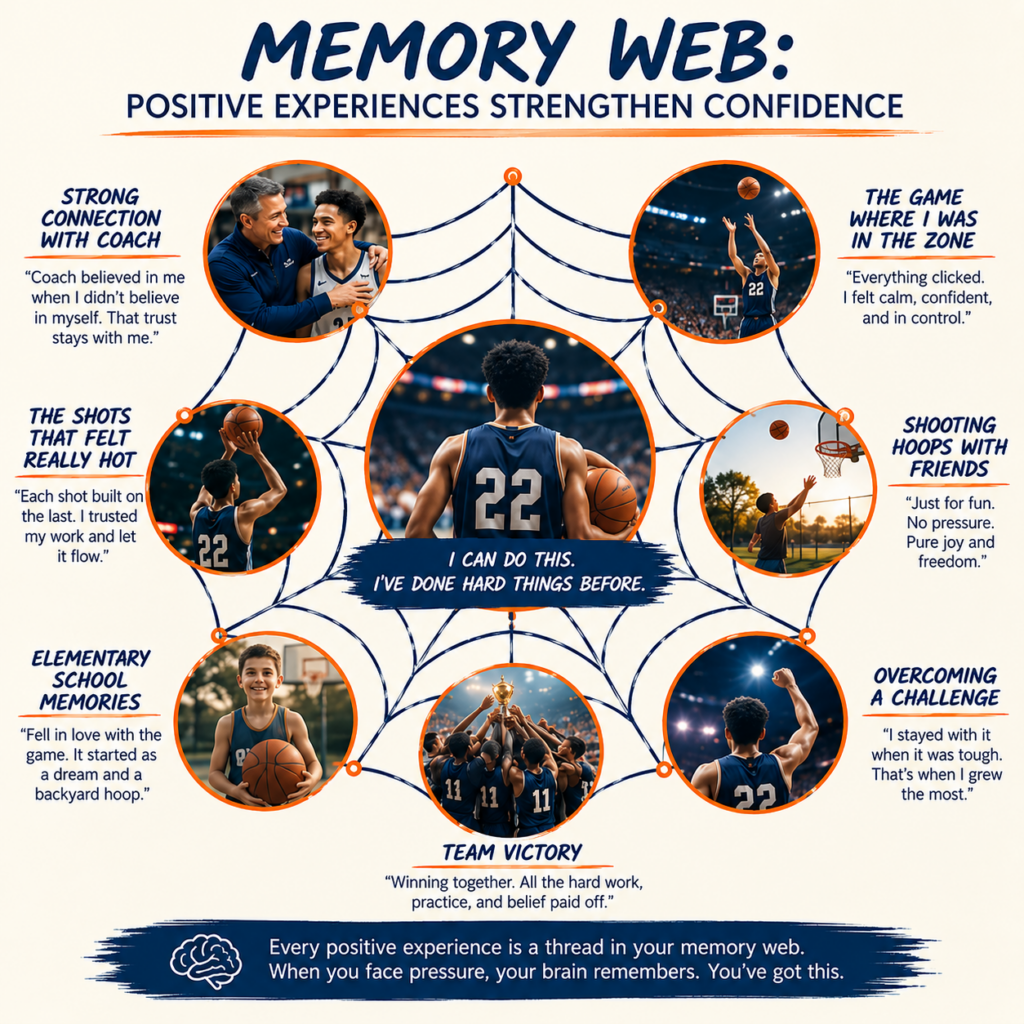
Imagine a spider web.
Touch one strand, and vibrations travel throughout the entire web.
The same process often occurs during athletic performance.
A missed free throw, critical feedback from a coach, sitting on the bench, a season-ending injury, or a public mistake may seem like isolated events. Yet when they share the same emotional meaning, they can become connected inside the same memory network.
For one athlete, missing a shot simply means:
“I’ll get the next one.”
For another, the exact same moment activates years of perfectionism, fear of failure, criticism, or feeling the need to constantly prove themselves.
The event is identical.
The nervous system response is completely different.
How Athlete Memory Networks Develop
Neuroscience suggests that memories are rarely stored as isolated events.
Instead, experiences with similar emotional significance naturally become linked together.
When something happens in the present that resembles an earlier experience, the brain may automatically activate those connected memories.
Most of the time, this process is incredibly helpful.
An athlete who repeatedly succeeds after remaining calm under pressure gradually builds a network associated with confidence and composure.
Each successful experience strengthens that pathway.
Eventually, confidence becomes easier to access because the brain has accumulated evidence supporting it.
The opposite can happen as well.
Repeated experiences involving criticism, embarrassment, exclusion, injury, or perceived failure can slowly become woven into the same network.
Eventually, one difficult moment activates much more than today’s event.
It activates years of emotionally similar experiences.
Have you ever watched an athlete react far more intensely than the situation seemed to warrant?
Often, the brain isn’t responding only to the present.
Just like turning on a light switch, a stressful moment can instantly illuminate memories stored within the same physiological state.
The Beliefs That Grow Inside Memory Networks
As memory networks strengthen, athletes often begin developing conclusions about themselves.
These are more than passing thoughts.
They become deeply felt beliefs that influence how future experiences are interpreted.
Common beliefs include:
- I’m not good enough.
- I don’t belong.
- I always mess things up.
- I’m letting everyone down.
- I’m a failure.
- I’m weak.
- I have to be perfect.
Over time, these beliefs become the lens through which athletes view new experiences. A coach’s feedback can be misinterpreted as a rejection, one performance is now proof that nothing is improving, or a difficult interaction with a teammate means “I don’t belong.” Rather than being created by a single event, these beliefs often emerge from repeated emotional experiences connected through implicit memory.
As discussed in the previous article, these thoughts are frequently the brain’s cognitive explanation for a nervous system that has already become activated.
Positive Athlete Memory Networks Can Grow Too
Fortunately, the brain remains capable of change throughout life.
Just as painful experiences strengthen negative networks, experiences involving resilience, confidence, mastery, connection, and recovery can strengthen adaptive ones.
This is one reason athletes benefit from intentionally noticing positive moments instead of immediately moving on to the next practice or competition.
Within EMDR therapy, this process is part of resourcing.
Athletes intentionally reconnect with experiences of confidence, composure, resilience, and peak performance.
By slowing down and fully experiencing what confidence feels like—including body sensations, emotions, images, and beliefs—the brain strengthens adaptive memory networks that become easier to access during future challenges.
Performance isn’t simply about remembering what to do.
It’s about accessing the nervous system state that allows existing skills and training to emerge when they matter most.
I often compare this to riding the same bike trail repeatedly.
Each ride creates deeper grooves in the path.
Similarly, repeatedly activating adaptive experiences strengthens the neural pathways that support confident performance under pressure.
Why Pre-Performance Routines Work
One reason routines are so valuable before competition is that they recreate the physiological conditions under which successful performances were originally encoded.
Breathing.
Posture.
Attention.
Emotional regulation.
These aren’t separate skills.
They’re all part of the memory network.
When athletes consistently prepare the same way, they increase the likelihood of activating the integrated network that supported previous success. They’re not simply warming up their muscles.They’re helping their brains access an established performance state.
Think about a basketball player stepping to the free-throw line.
Or a soccer player preparing for a penalty kick.
Notice how similar their routines often appear.
That’s not a coincidence.
Those routines recreate the conditions associated with previous successful performances.
The “hot hand” may represent more than confidence.
It may reflect a highly integrated memory network coming online.
As movement, attention, physiology, confidence, and sensory information become synchronized, athletes often describe feeling completely “locked in.”
Rather than consciously controlling every movement, the brain efficiently accesses an already integrated performance network.
Why Memory Networks Matter in EMDR Therapy
One reason I value EMDR therapy with athletes is that treatment goes far beyond simply encouraging positive thinking.
Instead, we identify and process experiences that continue fueling unhelpful memory networks while strengthening healthier, adaptive ones.
During intake and history-taking, recurring themes often emerge.
These themes provide a roadmap for treatment.
As earlier experiences are processed, athletes frequently discover that present-day mistakes no longer trigger overwhelming self-doubt.
The event still matters.
It simply no longer carries the emotional weight of every similar experience that came before.
What Coaches, Trainers, and Parents Can Watch For
You don’t have to be a therapist to recognize when an athlete’s nervous system may be reacting to more than the current moment.
Watch for sudden changes in state.
Examples include:
- Becoming physically rigid after a mistake.
- Explosive anger that seems disproportionate.
- Avoiding eye contact.
- Ignoring coaching feedback.
- Narrowed attention.
- Becoming overly cautious to avoid another mistake.
These reactions may indicate that the athlete isn’t responding solely to today’s performance.
Their nervous system may be interacting with years of accumulated emotional experiences.
Recognizing these patterns can foster greater empathy while helping coaches know when additional psychological support may be beneficial.
Final Thoughts
Understanding athlete memory networks helps explain why performance is rarely determined by a single play, competition, or mistake.
Instead, performance reflects the larger story the brain has gradually learned through repeated experiences.
The encouraging news is that these stories are not fixed.
The networks supporting confidence, resilience, and composure can continue to grow throughout an athlete’s career.
And when athletes begin changing those networks, they often discover something remarkable:
The same challenge that once triggered overwhelming self-doubt can eventually become another opportunity to perform with confidence and strengthen the felt sense of resilience.