
Summary Points
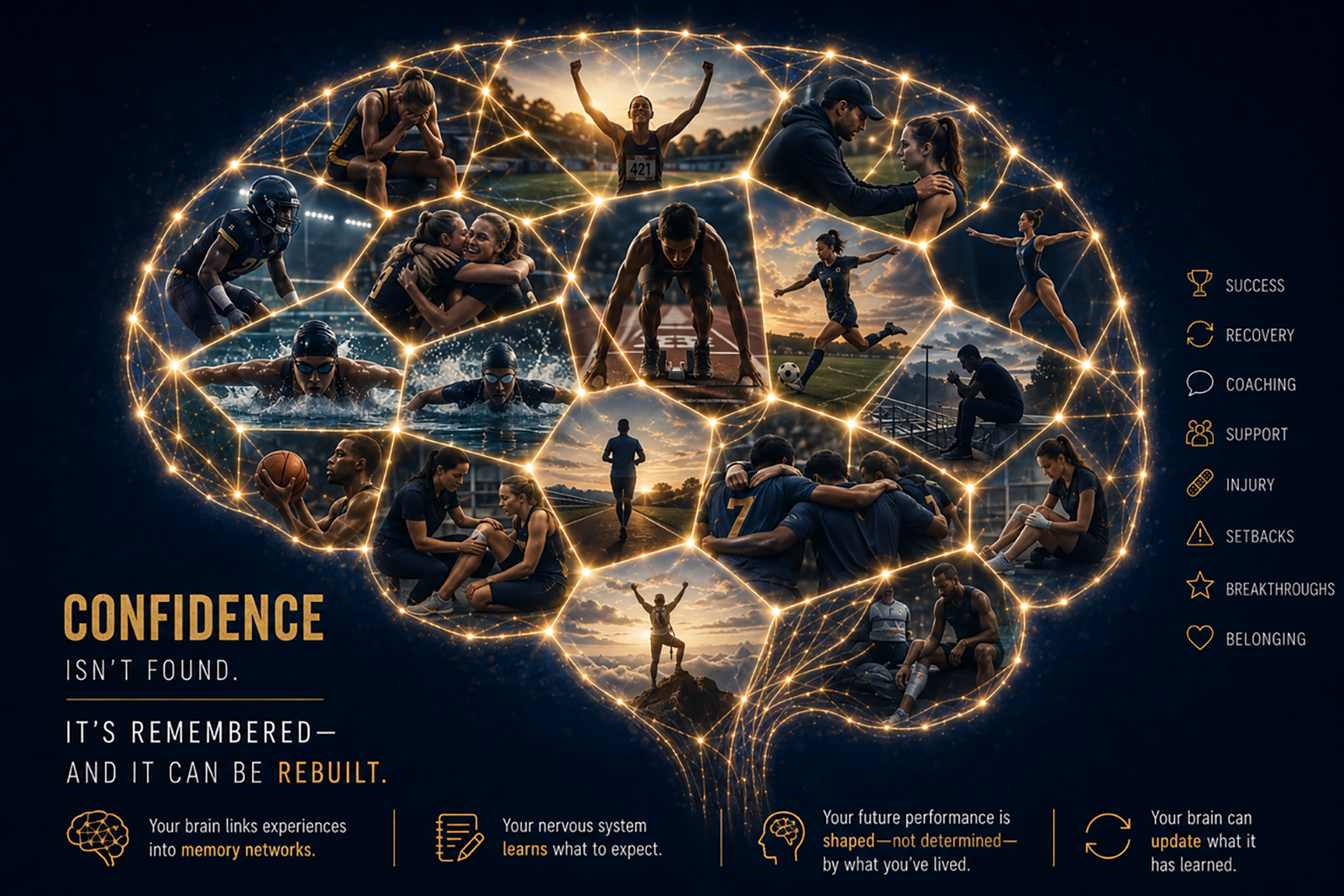
- Confidence is not simply something an athlete has or lacks. It grows from connected experiences stored in the brain.
- Past success, criticism, injury, failure, and encouragement can shape how the nervous system responds during competition.
- Athlete confidence memory networks can support performance or shift the athlete toward protection and threat detection.
- Positive thinking and mental skills can help, but they may not resolve deeper emotional learning on their own.
- EMDR and other trauma-informed approaches can help athletes process painful experiences and strengthen feelings of safety, competence, and resilience.
- Lasting confidence grows when the brain repeatedly records experiences of mastery, recovery, connection, and successful performance.
The Moment That Changed My Confidence
I used to think confidence was something you either had or lost—or could change a little through positive self-talk and hard work.
One memory from my sophomore year as a Division I athlete has stayed with me for decades.
I had been sick and temporarily moved to the practice squad. During a scrimmage, I was playing to earn my position back on the starting squad. I remember making a tackle with what felt like the right level of competition and aggression. I had been told by other coaches that my work ethic and pushing teammates in practice was a strength and an asset for the team.
So I was shocked when my coach exploded at me.
I can still remember the feeling in my body. It was as if years of confidence disappeared in a single moment.
After that day, I changed how I showed up in practice and competition. I was no longer playing to compete. I was playing not to make mistakes. I was playing not to get yelled at. Often athletes, coaches and leaders think of trauma as only major injuries, severe accidents or a catastrophic event (Big T trauma) yet micro-trauma including this relational interaction could register as a threat (Little t trauma.) I want to clarify not every coaching conflict or criticism or mistake or relational rupture is trauma. However, it is essential to bring awareness to how deeply the nervous system can be impacted by events that logically might not seem like a big deal on the surface.
Caution replaced instinct. I hesitated and constantly overthought plays. What frustrated me most was that I couldn’t understand how one interaction could have such a powerful impact on my confidence. For many years after I felt like should’ve had a stronger mindset and not let that memory impact me so much.
Now, years later, as an EMDR clinician who works with athletes and performers, I understand that experience very differently.
My confidence didn’t simply disappear.
Instead, my nervous system shifted into a more protective state. A sudden loss of safety or belonging in a high-stakes environment can register as a threat and the brain may organize future performance around preventing that pain again.
Confidence Is Shaped by Experience
While temperament likely influences confidence, our experiences continually shape and reshape it throughout life.
We often talk about confidence as though it is a personality trait. We say an athlete is naturally confident, mentally tough, or lacks confidence.
However, research from neuroscience, cognitive psychology, and learning theory suggests something more nuanced.
Confidence is not simply a motivational feeling or fixed personality characteristic. Instead, it grows from the brain’s network of past experiences, emotional learning, and body states.
Repeated, emotionally meaningful experiences strengthen groups of memories that shape how an athlete approaches the next moment of competition.
In other words:
Confidence may grow from a connected memory network rather than exist as a fixed personality trait.
Understanding athlete confidence memory networks can explain why an athlete may feel certain and instinctive in one situation but hesitant and overly self-conscious in another.
The athlete’s ability may still be present. However, a different group of memories, emotions, expectations, and physical responses may take control.
How Athlete Confidence Memory Networks Influence Performance
Performance psychologist Dr. Nate Zinsser, in his book The Confident Mind, defines confidence as a sense of certainty about your ability that allows you to bypass conscious thought and execute unconsciously.
He encourages athletes to recall past successes, build evidence of competence, and use positive self-talk. Mental skill like Zinsser’s are fantastic for building and strengthening top-down cognitive evidence, but predictive processing shows us why bottom-up nervous system responses can hijack those skills.
Neuroscience may help explain where that certainty comes from. Remember the spiderweb example I wrote about last week in the Athlete Memory Series when discussing memory networks?
From a predictive processing perspective, the brain does more than remember the past. It also uses past experiences to anticipate what may happen next.
Those predictions can influence:
- What an athlete notices
- How the body prepares to respond
- Whether a situation feels safe or threatening
- How much conscious control the athlete uses
- Which actions feel available in the moment
These processes can begin before an athlete consciously recognizes what is happening.
As a result, confidence may reflect more than an athlete’s current thoughts. It may also reflect what the brain and nervous system have learned to expect from previous experiences.
Why One Moment Can Change Everything
Athletes often feel confused when a single mistake, criticism, injury, or performance collapse suddenly changes the way they perform.
They may ask:
“If I know I can do this, why can’t I access it anymore?”
The answer often has little to do with ability.
Instead, a different memory network may have become active.
In my case, the coach’s reaction became linked with competition, aggression, evaluation, and performance. My nervous system began to connect those situations with possible danger.
Rather than playing freely, I started watching for threats and trying to prevent errors.
This was a protective, adaptive response—not weakness or a lack of mindset.
When the nervous system moves into a defensive state, confidence can feel unavailable even though the athlete still has the necessary skills.
The athlete may start consciously controlling movements that once felt automatic. They may watch for signs of criticism, hesitate before committing, or focus more on avoiding errors than pursuing success.
Therefore, the performance problem may not come from poor motivation. A protective emotional memory may have taken control.
The Hidden Architecture of Confidence
Think of confidence as a network of experiences rather than a single feeling.
An adaptive confidence network may include memories of:
- Executing skills successfully
- Recovering after mistakes
- Receiving encouragement from trusted coaches
- Feeling physically strong and prepared
- Performing effectively under pressure
- Belonging within a team
A protective confidence network may include memories of:
- Public criticism
- Injury
- Benching or being cut
- Performance failures
- Shame
- Fear of disappointing others
Both networks can exist within the same athlete.
The question is not simply whether confidence exists.
A more useful question is:
Which network is active in this moment?
For example, an athlete may have years of evidence showing that they are skilled and capable. However, a recent injury, public mistake, humiliating coaching interaction, or unexpected performance collapse may activate a stronger protective network.
The brain has not erased the athlete’s positive memories. Instead, the nervous system may struggle to access them while focusing on possible danger.
Adaptive and Protective Confidence Networks
Athlete confidence memory networks develop through repeated experiences. Over time, the brain connects situations, emotions, body sensations, beliefs, and expected outcomes.
An adaptive network may communicate:
- I know how to do this.
- Mistakes do not prevent me from recovering.
- Pressure is challenging but manageable.
- My body remembers the skill.
- This is a place where I belong.
A protective network may communicate:
- I have to be careful.
- One mistake could cost me everything.
- Other people may criticize or embarrass me.
- Trusting my body feels risky.
- Every movement needs conscious control.
These messages do not always appear as conscious thoughts. The athlete may experience them as tension, hesitation, overthinking, emotional numbness, loss of timing, or an urge to avoid competition.
This helps explain why two athletes with similar skills and preparation can respond very differently under pressure. Their nervous systems may use different sets of emotionally important experiences to predict what will happen next.
Confidence, therefore, involves more than believing the right thing. It also depends on which learning network the brain uses to understand the present moment.
When Positive Thinking Is Not Working
Traditional confidence-building strategies sometimes frustrate athletes.
Affirmations, visualization, goal setting, and other mental skills can provide valuable support. They may help athletes’ direct attention, create routines, and gather evidence of competence. Personally, I have my own positive mantra that helps on long-run days. I have been using it for decades, and some days it’s incredible- just what I need.
However, cognitive strategies alone may not fully reach the deeper emotional memory that drives the response when the nervous system has learned that competition is dangerous.
An athlete may repeatedly say, “I am confident,” while the body prepares for criticism, failure, pain, or humiliation.
This does not mean the athlete is weak or unwilling to change.
The brain is doing exactly what it was designed to do: use earlier experiences to predict danger and protect the person from experiencing it again.
In these situations, asking the athlete to think more positively may create additional frustration. The athlete already knows what they want to believe. The difficulty is that their nervous system may still operate from older emotional learning.
Effective support should address both the athlete’s conscious goals and the protective response beneath them.
Confidence Can Be Rebuilt
One of the most hopeful findings from neuroscience is that memory networks can change.
New experiences, emotional processing, and nervous system regulation can update previous learning.
EMDR therapy and other trauma-informed approaches may help athletes process experiences that the brain stored in a protective way. This work can also strengthen networks connected with competence, safety, flexibility, and resilience.
The goal is not to erase the past.
Instead, the goal is to help the nervous system recognize that the present differs from the past.
For example, an athlete may understand that a current coach offers support, a previous injury has healed, or one mistake does not define their ability. Even so, the nervous system may continue responding as if the old threat still exists.
Processing the earlier experience may help the athlete access more useful information in the present.
Over time, the athlete can build new evidence:
- Competition does not have to lead to humiliation.
- A mistake does not prevent recovery.
- My preparation is trustworthy.
- Pressure can feel intense without taking away my control.
- I can perform while staying connected to my body.
Results vary, and no single method works for every athlete. Still, trauma-informed care can provide an important option when traditional mental skills and additional practice have not resolved the problem.
A Different Question About Athlete Confidence
Looking back, I no longer ask:
“Why was I so weak that one coaching interaction changed my confidence?”
I ask a different question:
“What did my nervous system learn in that moment, and what experiences would help it learn something new?”
That question has changed the way I understand athletes, performance blocks, injury recovery, and confidence itself.
Perhaps the question is not:
“How do I become more confident?”
Instead, it becomes:
“What experiences has my nervous system learned to expect, and how can I help it build new ones?”
Confidence Can be Understood as Emerging from Memory Networks—and Memory Networks Can Change
Confidence grows when the brain repeatedly records experiences of safety, competence, mastery, belonging, and recovery. Connected memories shape what the athlete’s nervous system expects from the next performance. Some memories support freedom, instinct, and effective execution. Others encourage caution, self-protection, and error prevention.
Both responses make sense when we understand the athlete’s experiences.
As memory networks continue to evolve throughout life, so can the experiences that shape confidence. As a therapist, I have noticed that some of the most meaningful shifts happen when a person expects one outcome, yet experiences something different. These moments can update long-held beliefs and expectations and allow space for new possibilities.
Coming back to my own story, I reflect that confidence is not something that I had and then lost on that practice field many years ago. I can even smile when I think about younger version of myself- the athlete who worked hard for what she cared about, pursued her goals and learned through many challenges along the way. That same person is still here. I am still passionately pursuing goals, still learning, and curious and now exploring the intersection of neuroscience, performance and trauma-informed care. Perhaps, confidence in not something we attain and then perform and show up with and fear we can’t perform without it. Just maybe it is something we continue to build through the experiences that shape who we are becoming.