

Summary Points
- Performance memory updating in athletes may occur when an established memory is reactivated, and new information becomes available to the brain.
- Long-term memories can be stable without necessarily being permanently fixed.
- A difficult performance experience can become connected with emotions, beliefs, body sensations, and nervous-system responses within a larger memory network.
- Knowing intellectually that a past mistake does not define you may not be enough when the nervous system continues to react to what it remembers.
- Memory reconsolidation does not erase the past. Instead, under certain conditions, it may allow new learning to become integrated with an existing memory.
- Updating performance memory frees the nervous system from threat responses, unlocking smooth access to an athlete’s existing motor skills and procedural knowledge.
- EMDR therapy may help athletes process experiences that continue to feel emotionally or physiologically present.
- The goal is not to forget what happened but to help the brain and nervous system recognize that what happened before is not necessarily what is happening now.
What if an old performance memory isn’t as fixed as we think?
I found myself thinking about that question recently—not in my office, but halfway up a mountain this last weekend.
My family and I had set an ambitious goal: to attempt three summits in one day, all above 14,000 feet. We started in the middle of the night, with very little sleep, and we pushed the pace early. Within the first couple of miles, we had already gained significant elevation.
I didn’t feel great. A slight headache, nausea, and a strange metallic taste had started to set in, and I couldn’t regulate my body temperature, so I kept adding and removing layers. At the time, I wasn’t sure exactly what was causing the symptoms, but I thought if I kept hydrating and moving, I would soon enough start to feel back to normal.
I used my self-talk, breathing techniques and sensory grounding tools but continued to struggle.
Eventually, with the summit ridge in sight, I had to make a difficult decision to head back down to the trailhead. I started with the ambitious goal of three peaks, knowing two peaks was really possible and then feeling awful told myself I could go down after the first peak. I never considered I would not summit any of the peaks that day unless weather was a factor.
Part of me desperately wanted to keep going.
I could see the ridge. Having climbed mountains before, I knew I was capable of doing hard things. There was also the memory of standing on top of a peak with my family, taking in the sunrise and the awe-inspiring landscape, then feeling the good exhaustion from pushing through something hard at the end of the trail and sharing those experiences of adventure together.
But I also knew that continuing wasn’t worth compromising my safety—or my family’s safety.
So I turned around, and my amazing husband turned around with me.
What happens after a difficult experience?
Interestingly, the hardest part wasn’t necessarily making the decision.
It was what happened afterward.
As I descended, I felt doubt.
Would I be able to climb another high-altitude mountain?
Had I lost something? Would my body feel the same next time, and would this become the memory I carried into my next attempt?
I felt disappointed. Frustrated. And, if I’m being completely honest, there was a moment when I felt like I had failed.
By the time I reached the trailhead, I threw up. Once I got down to a lower elevation, I began feeling better.
And now I have another summit attempt planned later this month.
There’s still some doubt, which I think makes sense.
But I also feel hopeful and have reflected on strategy, including pacing the ascent for the first mile differently.
I plan to pay attention to my pace, sleep, fueling, symptoms, and how my body is responding rather than assuming that because I have done something before, I should be able to do it again under different circumstances.
And this experience has made me curious about something beyond the mountain itself.
What will my brain do with this memory?
How does the brain update what it remembers?
Will this experience become evidence that says, “Maybe I can’t do this anymore”?
Or will it become part of a much larger network of memories that says, “I made a difficult decision to keep myself and my family safe. I listened to my body. I learned something. And I can try again.”
Could this new experience change how I remember the other mountains I’ve climbed?
Perhaps the memory of turning around will sit alongside memories of reaching summits, doing hard things, and sharing adventures with people I love.
I don’t know yet.
And maybe that’s part of what makes memory so fascinating.
Because the brain doesn’t simply store each experience in isolation.
New experiences are continually being integrated with what we’ve learned before.
Sometimes, an experience may reinforce an existing belief.
Other times, it may challenge one.
And under certain conditions, when an established memory is reactivated and the brain encounters new information that contradicts its old expectation- that memory trace may temporarily open up to integrate new learning.
That process is called memory reconsolidation.
Understanding memory reconsolidation: the two glasses of water
Years ago, I heard a story in a training that has stayed with me ever since. I’ve shared it with clients over the years because it offers such a simple way to think about something that can otherwise feel incredibly complicated.
Imagine you have two glasses of water sitting in front of you.
One is completely clear.
The other has red food coloring mixed into it.
Now imagine you have a small dropper. You begin moving tiny amounts of the red-colored water into the clear glass.
At first, you may not notice much of a difference.
Drop after drop, the water still looks clear.
But eventually the color becomes noticeable.
The original clear water has not disappeared, but it has been influenced by what was introduced into it.
The brain, of course, doesn’t work like two glasses of water.
But I think this image offers a useful way to understand an important idea about memory:
When an established memory is reactivated, under certain conditions, it can become temporarily more modifiable. New information may then become incorporated before that memory is stored again.
Again, this process is called memory reconsolidation.
And for athletes, this matters.
Because sometimes what looks like a performance problem or failure in the present may have something to do with what the brain learned in the past.
It is helpful to remember that a difficult performance doesn’t destroy your underlying physical skills- your procedural memory, or “muscle memory,” stays intact in the brain. Instead, high-stress events can create strong emotional memory networks that block access to those skills when the threat response gets triggered.
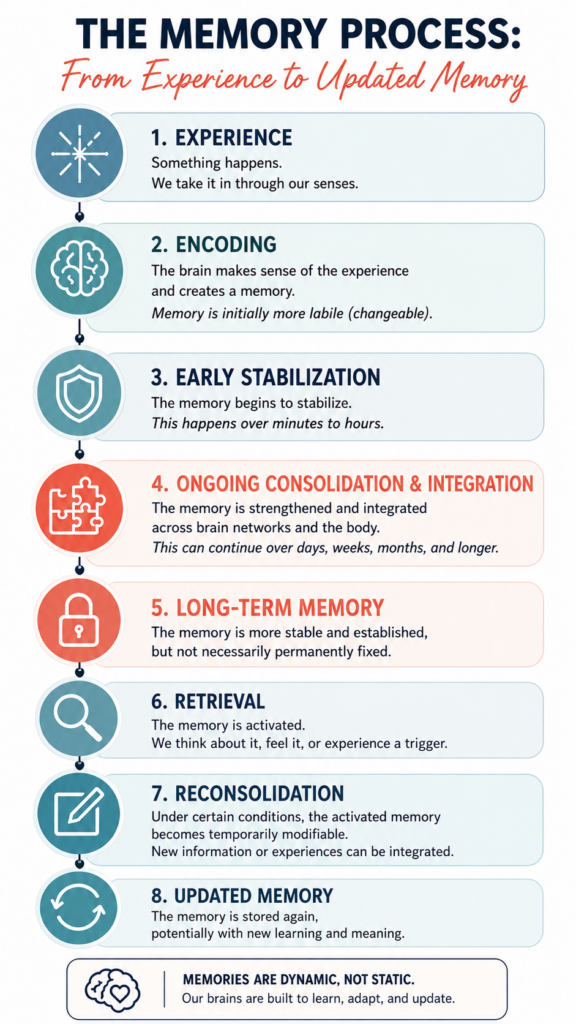
First, what exactly happens to a memory after we experience something?
When something happens, the brain takes in an enormous amount of information.
- What happened
- What we saw and heard
- How we felt
- What we thought
- What our body experienced
- And what we learned about ourselves and the world.
But before a memory becomes part of long memory, we also rely on short-term, or working, memory– the temporary mental work space for information we are actively processing. It allows us to hold on to something for a moment while we make sense of it, respond to it, or connect it to what we already know.
When information becomes important or meaningful enough, aspects of that experience can undergo consolidation, becoming more stable and integrated into long-term memory.
But there isn’t one precise moment when a memory suddenly changes from “unconsolidated” to “permanent.”
Some aspects of memory begin stabilizing over minutes and hours. Other aspects continue to be reorganized and integrated over much longer periods—days, weeks, months, and potentially longer.
Memory consolidation is an ongoing process
So rather than thinking:
Unconsolidated → permanent
It may be more accurate to think:
Experience → encoding → stabilization → ongoing consolidation and integration → long-term memory
Working memory helps us actively hold and process information in the present, but it isn’t a “waiting room” before long-term memory.
And here’s the fascinating part:
Long-term doesn’t necessarily mean locked forever.
A memory can be stable without being fixed.
For a long time, memory was often described as though the brain stored experiences and then simply retrieved them later.
We now understand that memory is much more dynamic.
When an established memory is retrieved, it may, under certain conditions, temporarily become more malleable.
This creates a window in which new information or learning may be incorporated before the memory is stored again.
A simple way to think about it is:
Retrieve → become temporarily modifiable → incorporate new learning → store again
However, there is an important scientific caveat.
Retrieving a memory does not automatically mean that the memory is completely rewritten.
Reconsolidation appears to depend on specific conditions, including how the memory is activated and whether something meaningfully challenges or updates what was previously learned or differs from what the brain expected. Neuroscientists refer to this as “prediction error” a meaningful mismatch between what the nervous system expected based on past experience and what actually happens in the present moment. That mismatch signals to the brain- this memory needs an update.
That distinction matters.
Because the goal isn’t to erase a memory.
It’s to understand that the brain may have more flexibility than we once thought.
Think about your phone
Most of us are used to seeing the same notification:
An update is available.
On your phone.
or your computer.
An app you’ve been using for years.
Sometimes the update is tiny. You might barely notice a difference.
Other times, an update changes how the system functions.
Our brains and bodies aren’t computers, of course.
But the metaphor is useful.
We are built to adapt.
Also constantly learning from experience.
And our nervous systems are continually integrating new information with what we have learned before.
The brain isn’t simply a filing cabinet.
It is an adaptive system.
And sometimes, what we learned in the past may need to be updated by what we know and experience now.
How performance memory updating in athletes affects performance
Imagine an athlete who made a critical mistake during an important competition. The mistake itself may have been only one moment.
But perhaps that moment became connected with much more:
- Fear.
- Embarrassment.
- A coach’s criticism.
- Disappointment.
- A physical sensation of panic.
- A feeling of losing control.
And perhaps it became associated with a belief such as:
“I’m not good enough.”
Or:
“I can’t trust myself under pressure.”
The brain doesn’t necessarily store each of these experiences in isolation.
They can become connected within a memory network.
Later, something in the present can activate that network.
A particular opponent.
A high-pressure situation.
Perhaps it’s a coach’s expression or even a familiar bodily sensation.
The anticipation of making another mistake.
Suddenly, the athlete may not be responding only to what is happening right now.
Their nervous system may also be responding to what the current moment reminds their brain of.
This is why knowing better isn’t always enough
An athlete might say:
“I know that mistake doesn’t define me.”
And they may genuinely believe it.
They may have spent months learning mental skills and may understand performance psychology.
Perhaps they know how to breathe, regulate their attention, and recognize what they are supposed to think.
Still, when the moment arrives, their body may react before their conscious mind can catch up.
The heart races and muscles tighten.
Attention narrows, while the athlete becomes hyperaware of every movement.
They hesitate.
They may begin to over-control something that normally happens automatically.
Or suddenly, it feels as though they are back in that old moment again.
This is one reason I believe performance work sometimes needs to look beyond mental skills alone.
The question isn’t only:
“What is the athlete thinking?”
It can also be:
“What is the athlete’s nervous system remembering?”
That distinction can be especially important when understanding memory, nervous-system responses, and athletic performance.
How athletes can update performance memories
Imagine that the same athlete has had years of experience since the original event.
Since then, they’ve developed skills, matured, and experienced success.
They may have built supportive relationships and learned how to regulate their nervous system.
Along the way, they’ve survived difficult moments and discovered that making a mistake doesn’t mean the end of the world.
But the old memory network may still carry information from a time when those resources weren’t available.
This possibility is central to performance memory updating in athletes because new experiences may challenge what an older memory network still expects.
This is where memory reconsolidation becomes particularly interesting.
Under appropriate conditions, when an old memory is activated, new information may become available to the system.
That new information isn’t:
“That never happened.”
Nor is it:
“I shouldn’t feel this way.”
And it certainly isn’t:
“Just think positively.”
Instead, perhaps the nervous system begins to recognize:
“That happened then. This is now.”
“Today, I have resources that I didn’t have then.”
“Making a mistake doesn’t mean I’m unsafe.”
“Activation can be present without taking away my sense of control.”
“And I can learn to trust myself again.”
Not every doubt, failure or difficult performance or life experience requires therapy.
Our brains are naturally wired for processing and integration. Often through rest, reflections, safe connections, or just having a different successful experience the next time, the brain naturally updates its memory network. The old experience is integrated, and the nervous system settles on its own.
I’ll be curious to see how my brain handles my next climb- whether the recent turn-around before the summit naturally settles into a broader narrative of having the courage to take on challenges and then respond, or if a piece of doubt lingers.
Either way the invitation is to stay curious about your own mind and body.
Notice what your brain holds on to, notice how past events show up in your current performance, and remember whether through natural integration or focused therapeutic support such as EMDR, our memories are far more adaptable than we often think.
Performance memory updating in athletes does not mean erasing the past
The original memory doesn’t have to disappear.
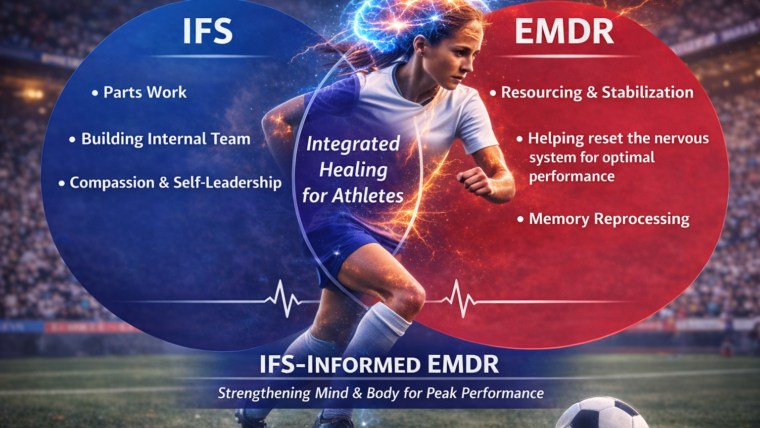
The athlete doesn’t have to pretend the experience didn’t matter. Instead, the memory may become integrated into a broader, more current understanding of what happened. As an EMDR clinician, I am interested in the intersection of memory, nervous-system responses, and performance.
When we work therapeutically with a distressing experience, the goal isn’t simply to make an athlete forget.
We carefully consider the athlete’s current stability, resources, readiness, and processing capacity.
Then, when appropriate, we can work with experiences that continue to feel emotionally or physiologically present.
The process can involve memories, beliefs, emotions, body sensations, and associations that have become connected within a larger network.
And sometimes, as those experiences are processed, something changes.
The athlete may still remember what happened.
But the experience no longer carries the same meaning.
The body may no longer respond with the same intensity.
Beliefs about the self can become less absolute.
Meanwhile, the present begins to feel more distinguishable from the past.
And there is more room for choice.
The goal isn’t to erase the past
This distinction is important.
Memory reconsolidation is not about deleting painful experiences.
And EMDR isn’t about pretending that something difficult never happened. The past remains part of the athlete’s story. But perhaps it doesn’t have to remain in charge of the present.
An athlete can remember the mistake without reliving it.
An injury can remain part of their history without creating ongoing anticipation of another.
Criticism can be remembered without automatically being believed.
Even the moment they lost confidence can remain in memory without becoming evidence that confidence is permanently gone.
The memory can remain.
The relationship to the memory can change.
This is one of the most meaningful possibilities in performance memory updating for athletes: the event remains part of the athlete’s history without dictating the athlete’s present response.
Maybe that’s the most hopeful part
Think back to the two glasses of water.
The red water doesn’t disappear.
The original experience doesn’t disappear.
But when a system is open to new information, what is already there can be influenced by what comes next.
And think about that familiar technology notification:
An update is available.
We don’t throw the entire system away because an update is needed.
Nor do we erase everything the system has already learned.
Instead, new information becomes incorporated into the existing system.
Our brains and nervous systems are infinitely more complex than a phone or a glass of water. But they share one important quality with both metaphors: They are capable of change.
For athletes, that possibility can be powerful.
Change can help the athlete’s brain and nervous system recognize something that is already true:
What happened before is not necessarily what is happening now.
And perhaps the most important question isn’t:
“How do I forget what happened?”
It is:
“What does my brain still believe about that experience—and what might it need to learn now?”
A simple way to remember it
The takeaway for athletes
Your brain remembers.
Your body remembers.
But remembering does not necessarily mean being stuck.
Our experiences shape us.
But with the right conditions, support, and new experiences, the brain and nervous system can continue to learn.
Performance memory updating in athletes helps explain why the past may influence the present without permanently determining what happens next.
Sometimes, changing what the past means to the nervous system creates more freedom for what becomes possible in the present.
I have another summit attempt planned later this month. I’ll be curious to see how the experience goes and how my brain and body respond when I’m back on the trail.