
Reflections from the Inaugural College Athlete Mental Health Conference in Houston
Key Takeaways
- Performance is closely linked to nervous system regulation in athletes.
- EMDR therapy for athletes helps process unresolved stress responses that interfere with performance.
- Performance blocks are often nervous system protection responses—not a lack of discipline or talent.
- Hyperarousal and hypoarousal can both disrupt instinctive athletic execution.
- EMDR and Brainspotting help athletes reconnect with timing, trust, confidence, and flow.
- Modern athletes face unprecedented psychological pressure from competition, identity, social media, NIL demands, and constant evaluation.
- Nervous system regulation is increasingly recognized as a core component of athlete mental health and elite performance.
- Athletes often report feeling more present, calm, and connected to their training after EMDR therapy.
Introduction: When the “Game Film” Gets Stuck on Repeat
Many athletes know this experience:
You’ve trained well. Your body is prepared. Your skills are sharp.
And then competition begins… and something shifts.
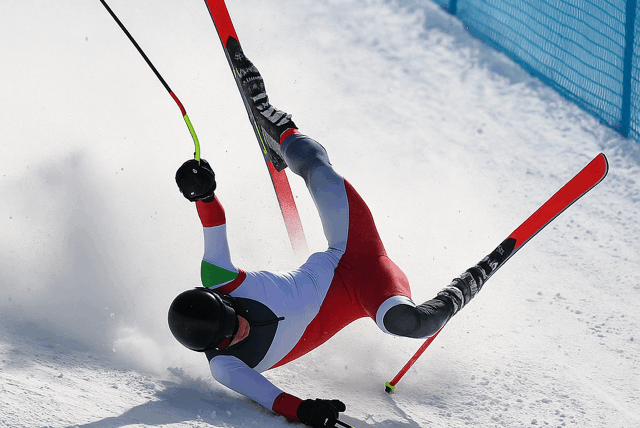
It can feel like the game film gets stuck in a loop. Mistakes replay in your mind, your body tightens, and instinctive performance suddenly becomes harder to access.
This is not necessarily a lack of ability.
More often than not, it reflects a dysregulated nervous system under pressure.
I sometimes explain it this way: imagine your brain is like game film. After every performance, the brain is supposed to review the experience, learn from it, and file it away correctly. But occasionally, a moment loaded with strong emotion—such as an injury, a critical mistake, public embarrassment, or a high-pressure failure—does not process properly.
Instead of being archived, it keeps replaying.
When athletes later enter similar situations, the brain and nervous system may react not only to the present moment, but also to the old “film” still stuck on repeat.
This is where EMDR therapy for athletes can be transformative.
Eye Movement Desensitization and Reprocessing (EMDR) helps the brain process and integrate unresolved experiences so they no longer feel as if they are still happening in the present.
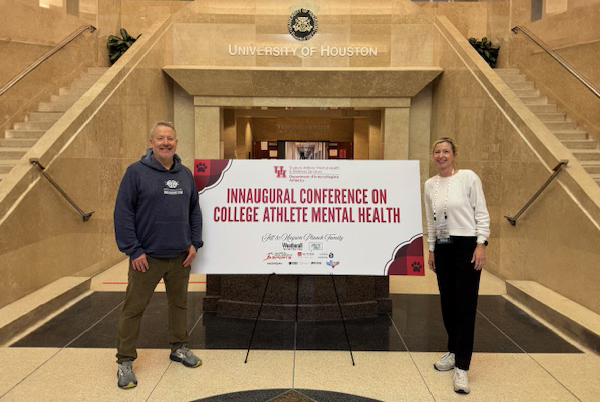
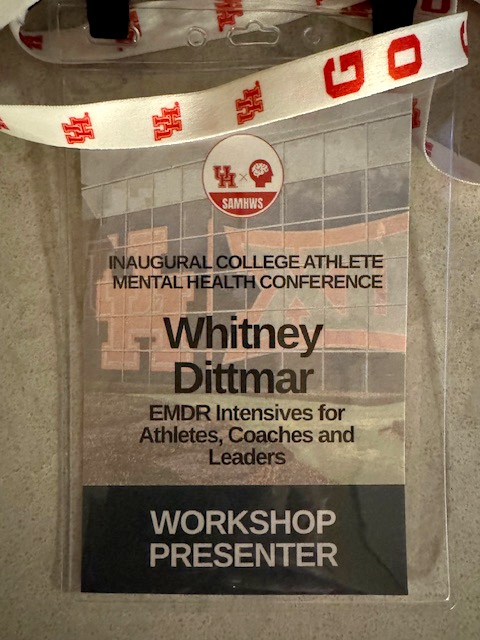
At the inaugural college athlete mental health conference in Houston, I had the privilege of presenting about EMDR alongside a respected colleague who specializes in Brainspotting. Together, we explored how EMDR and Brainspotting can help athletes reset the nervous system and regain access to trust, timing, confidence, and performance flow.
Since EMDR therapy with athletes, coaches, and high performers is a major focus of my work, I wanted to share some of the key ideas from our presentation for those who were unable to attend.
EMDR Therapy for Athletes and Performance Enhancement
EMDR is an evidence-based therapy approach used worldwide for trauma treatment, nervous system regulation, and increasingly, athletic performance enhancement.
In sports, EMDR helps process experiences and nervous system responses that traditional talk therapy may not fully reach.
Rather than focusing exclusively on thoughts or motivation, EMDR works directly with the brain-body system to help athletes:
- Process unresolved experiences affecting current performance
- Reduce anxiety, hypervigilance, and overactivation
- Address shutdown states, such as numbness or emotional disconnection
- Restore instinctive access to trained skills
- Improve nervous system flexibility under pressure
- Rebuild trust in the body during competition
The goal is not to relive painful moments repeatedly.
The goal is to help the nervous system move out of protection mode and return to regulation.
When this happens, athletes frequently describe feeling:
- More present
- More confident
- More connected to their training
- Less controlled by fear or overthinking
- Better able to access flow states naturally
What Performance Blocks Look Like in Athletes
Performance blocks are often misunderstood.
Athletes may be labeled as inconsistent, mentally weak, distracted, or “too much in their head.” In reality, many of these struggles are nervous system responses to stress and pressure. In our presentation we showed video clips and gave some general case examples to help show how stuck stress might present in the nervous system. I also shared part of my own story as a Division 1 athlete, realizing years later through EMDR how my nervous system had shifted into a freeze response that left me playing not to make mistakes rather than playing freely. At that time, it was confusing and frustrating because no amount of training, motivation or mental effort seemed to help me access the free-flow state I wanted to be in while competing.
Common signs of athletic performance blocks include:
- Performing well in practice but struggling in competition- performance collapse under pressure
- Playing cautiously to avoid mistakes- playing not to mess up
- Overthinking during key moments
- Loss of rhythm, timing, or coordination
- Excessively rigid movement patterns
- Difficulty trusting instinctive reactions
- Emotional shutdown during games
- Feeling disconnected from teammates
- Trying to force outcomes instead of responding naturally
- Sudden hesitation in familiar situations
These patterns often reflect a nervous system attempting to stay safe.
They are not necessarily signs of poor preparation, lack of confidence, or lack of talent.
Understanding this distinction is critical for athlete mental health and long-term performance development.
Hyperarousal and Hypoarousal in Athletic Performance
Athletes struggling with performance anxiety or emotional inconsistency often fluctuate between two nervous system states: hyperarousal and hypoarousal.
Hyperarousal (Fight-or-Flight Activation)
Hyperarousal occurs when the nervous system becomes excessively activated.
Athletes may experience:
- Racing thoughts
- Competition anxiety
- Muscle tightness
- Overcontrol during performance
- Fear of mistakes
- Difficulty accessing instinctive reactions
- Increased tension and urgency
In this state, athletes often attempt to “force” performance rather than trust their training.
Hypoarousal (Shutdown Response)
Hypoarousal reflects a shutdown or collapse response within the nervous system.
Common signs include:
- Emotional numbness
- Flatness or lack of emotional engagement
- Feeling disconnected from the game
- Reduced energy
- “Checked out” sensations
- Withdrawal from teammates
- Loss of competitive presence
Both hyperarousal and hypoarousal are protective nervous system responses.
Neither represents weakness.
However, when these states become chronic or unresolved, they can significantly interfere with athletic performance, confidence, and recovery.
Inaugural College Athlete Mental Health Conference
Why Athlete Mental Health Matters More Than Ever
Today’s athletes are performing in increasingly demanding psychological environments.
College and elite athletes often navigate:
- Limited recovery time
- Intense training schedules
- Constant comparison and evaluation
- Social media pressure
- NIL (Name, Image, and Likeness) responsibilities
- Transfer portal uncertainty
- Injury recovery challenges
- Identity disruption after setbacks
- The sports betting culture surrounding the competition
- Increased performance identity fusion
Because of these realities, athlete mental health cannot be treated as a secondary issue.
There is no true off-season for the nervous system and key message from the conference was “Mental health has no offseason.”
The pressure athletes carry often extends far beyond the field, court, track, or gym.
This is one reason why approaches focused on nervous system regulation—including EMDR therapy for athletes—are becoming increasingly important within sports psychology and performance care.
EMDR Therapy for Performance Anxiety and Nervous System Regulation
EMDR is increasingly being used not only for trauma and injury recovery, but also for:
- Performance anxiety
- Confidence blocks
- Competition stress
- The yips
- Fear of failure
- Emotional overwhelm
- Recovery from high-pressure mistakes
Instead of repeatedly analyzing experiences cognitively, EMDR helps the brain and body:
- Reprocess unresolved experiences
- Reduce threat-based activation
- Improve emotional regulation
- Restore access to learned skills
- Increase adaptability under pressure
- Support more instinctive performance
This is why many athletes say EMDR helps them “trust their training again.”
Performance becomes less about controlling every outcome and more about allowing trained skill to emerge naturally.
That shift can be powerful.
The Growing Role of Nervous System Regulation in Sports Performance
One of the most encouraging developments in sports psychology is the growing recognition that performance is not driven by mindset alone.
The nervous system plays a direct role in:
- Confidence
- Decision-making
- Coordination
- Emotional regulation
- Recovery
- Focus
- Reaction speed
- Social connection
- Resilience under pressure
Athletes do not perform optimally simply because they “want it more.”
They perform best when the nervous system feels regulated enough to access training, adaptability, creativity, and instinctive execution.
This shift in understanding is changing how clinicians, coaches, and performance specialists approach athlete care.
Final Reflection: Supporting Athletes Beyond the Mental Game
It was an honor to collaborate with clinicians, researchers, and advocates at the Houston conference who are helping advance the field of college athlete mental health.
The conversation around performance is evolving.
We are moving beyond simply telling athletes to “be mentally tough” and toward understanding how nervous system states directly shape performance, recovery, resilience, and well-being.
The nervous system drives performance—not just thoughts.
When the nervous system remains stuck in protection mode, performance becomes limited, not because of talent, but because of state.
When regulation is restored through approaches like EMDR therapy for athletes and Brainspotting, athletes often experience more than improved performance.
They regain access to themselves.